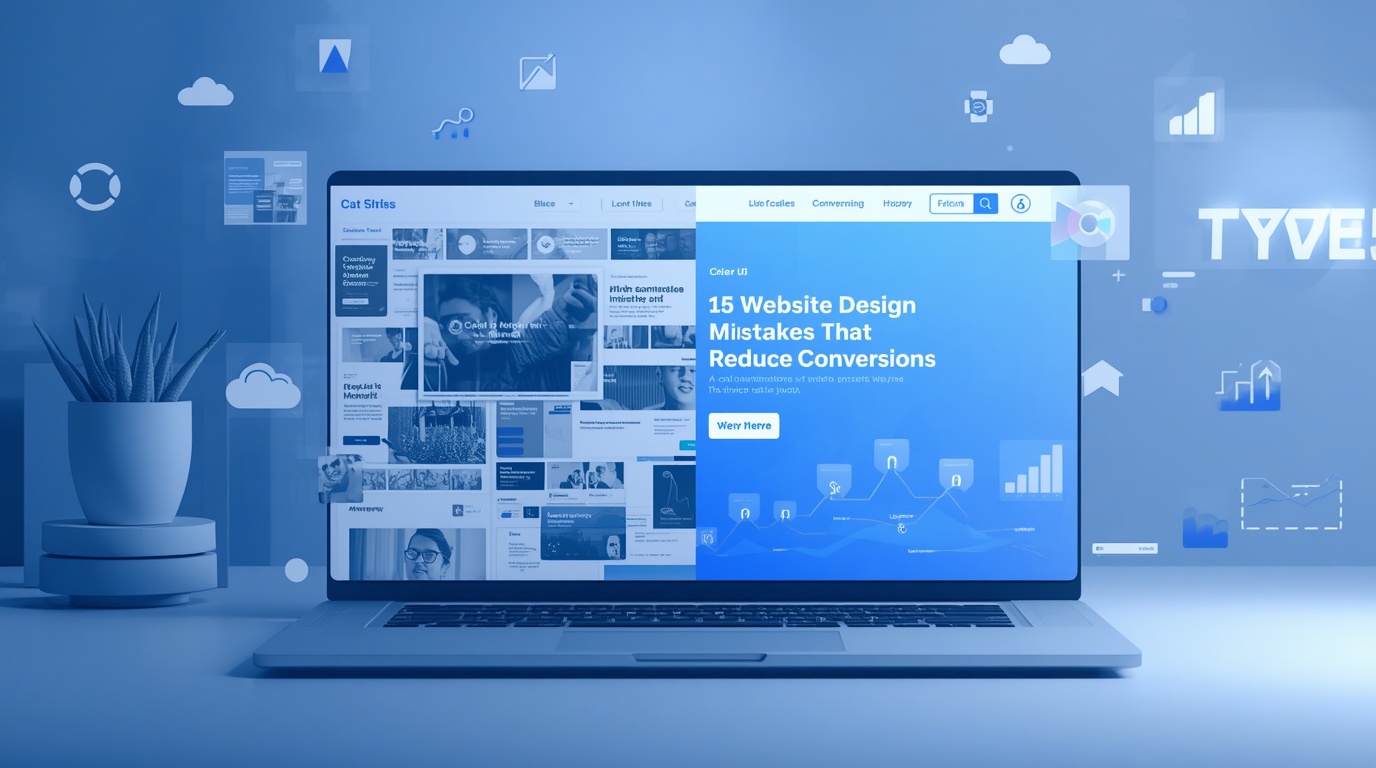
15 Website Design Mistakes That Reduce Conversions
A business owner in Dallas checks the analytics dashboard every morning and sees the same story. Hundreds of visitors are arriving on the website, the traffic numbers look healthy, and yet the phone barely rings and the contact form sits nearly empty. Somewhere between the click and the conversion, trust quietly breaks down. The website looks fine on the surface, but underneath it is working against the business, not for it. This is the reality for thousands of companies across the United States right now, and it is exactly why so many are turning to professional wordpress web development services instead of settling for a template that was never built with conversions in mind.
Most business owners assume a website problem is a traffic problem. It rarely is. The real issue is almost always design, structure, and psychology working against the visitor at every step. A skilled team offering wordpress web development services understands that a beautiful homepage means nothing if the layout confuses visitors, the navigation buries the offer, or the mobile experience feels clunky on a phone in Houston or Miami. Conversion is not decided by how a site looks in a portfolio screenshot. It is decided in the first three seconds a real person spends on the page, and it is decided again and again through every click that follows.
This guide breaks down the fifteen most damaging website design mistakes quietly costing businesses leads, sales, and long-term growth in 2026, along with the psychological reasons behind each one and what an experienced ecommerce web Design and development company, custom web Design and development company, B2b web Design and development company, Shopify web Design and development company, or Corporate web Design and development company actually does differently to fix it.
[CTA text="Don't let design mistakes cost you sales. Enter your URL below to get a personalized conversion audit and fix what's broken." href="/contact" label="Get Your Free Website Audit]
Why Trust Disappears Before Visitors Even Read the Page
Before a visitor reads a single sentence, their brain has already made a judgment. Studies on visual credibility consistently show that people form an opinion about a website's trustworthiness in well under a second, long before they process any text. That judgment is based entirely on design cues: spacing, typography, color balance, image quality, and layout consistency. If those cues feel off, even slightly, the visitor's guard goes up and everything that follows gets read with suspicion instead of interest.
This is the invisible tax most businesses never account for. A site can have excellent copy, a strong offer, and competitive pricing, and still lose the sale because the design triggered doubt in the first instant. Conversion-focused web design exists specifically to close that gap between first impression and first action.
What Makes Users Leave a Website Within Seconds
Users leave fast, and they leave for predictable, repeatable reasons. Below are the fifteen mistakes responsible for the vast majority of lost conversions, along with why each one hurts, the psychological trigger behind it, the business cost, and the fix.
1. Poor Mobile Responsiveness
Why it hurts: More than half of web traffic across cities like Austin, Seattle, and Atlanta now comes from mobile devices. A layout that was designed desktop-first and simply shrunk down creates cramped buttons, overlapping text, and awkward scrolling.
Psychological impact: Frustration sets in almost immediately, and frustration reads as incompetence.
Business consequence: Lost leads, higher bounce rate, and lower mobile conversion optimization performance in Google's mobile-first indexing.
Solution: True mobile responsive architecture built from the ground up, not a desktop layout stretched or squeezed to fit.
2. Slow Loading Pages
Why it hurts: Every additional second of load time measurably increases abandonment. Website speed optimization is not a technical nicety anymore, it is a revenue lever.
Psychological impact: Waiting creates impatience, and impatience gets transferred onto the brand before the visitor sees a single product or service.
Business consequence: Poor Core Web Vitals scores, weaker rankings, and visitors who leave before the value proposition even loads.
Solution: Image lazy loading, script deferral, optimized hosting, and a Lighthouse performance score built into the development process from day one.
3. Weak Visual Hierarchy
Why it hurts: When everything on the page competes for attention, nothing gets attention.
Psychological impact: Cognitive overload triggers decision fatigue, and a fatigued visitor closes the tab.
Business consequence: Lower engagement, weaker calls-to-action performance.
Solution: Deliberate visual hierarchy that guides the eye from headline to proof to action.
4. Confusing Navigation
Why it hurts: If a visitor cannot find what they came for within a couple of clicks, they assume it does not exist.
Psychological impact: Confusion triggers a fear response, so visitors leave rather than dig.
Business consequence: High exit rates on service and product pages.
Solution: Clear information architecture based on real user behavior.
Stop guessing—download the full checklist of 15 mistakes and run through your site step-by-step to boost conversions today.
Send Me the Checklist5. Cluttered Layouts
Why it hurts: Dense pages packed with competing sections overwhelm the visitor before they process the message.
Psychological impact: Clutter reads as chaos, and chaos signals disorganization behind the scenes.
Business consequence: Reduced time on page and fewer qualified inquiries.
Solution: Deliberate white space and a conversion-focused UI system.
6. Weak Calls-to-Action
Why it hurts: A vague or buried call-to-action gives the visitor no clear next step.
Psychological impact: Uncertainty stalls decision-making.
Business consequence: High traffic, low conversions.
Solution: Strong, specific, visually prioritized CTAs at every key decision point.
7. Poor Accessibility
Why it hurts: Sites that ignore accessibility standards exclude a meaningful share of potential customers.
Psychological impact: Visitors using assistive technology disengage on first friction.
Business consequence: Lost customers, legal exposure, weaker page experience signals.
Solution: Semantic HTML, proper alt text, keyboard navigation, accessibility-first standards.
8. Inconsistent Branding
Why it hurts: When fonts, colors, and tone shift from page to page, the brand feels unreliable.
Psychological impact: Consistency builds subconscious trust.
Business consequence: Weaker brand recall and lower perceived credibility.
Solution: A documented, enforced design system applied across every template.
9. Too Many Form Fields
Why it hurts: Every additional field is another moment for the visitor to reconsider.
Psychological impact: Long forms feel like a demand rather than an invitation.
Business consequence: Lower form completion rates.
Solution: Short, focused forms asking only for what is needed at that stage.
10. Low Trust Signals
Why it hurts: Visitors researching a company look for proof before they commit.
Psychological impact: Humans seek social proof before deciding, especially in B2B.
Business consequence: Longer sales cycles, lower conversion rates.
Solution: Visible testimonials, case studies, and certifications near decision points.
11. Poor Content Hierarchy
Why it hurts: Dense text without structure makes visitors work too hard.
Psychological impact: Effort creates friction, and friction kills momentum.
Business consequence: Higher bounce rates on service and blog pages.
Solution: Scannable formatting with short paragraphs and subheadings.
12. Weak Product or Service Presentation
Why it hurts: Unclear presentation gives visitors no reason to choose this business.
Psychological impact: Ambiguity increases perceived risk.
Business consequence: Lost sales to competitors with clearer presentation.
Solution: Benefit-driven copy paired with strong visuals.
13. Generic Stock Imagery
Why it hurts: Overused stock photos are recognized instantly as inauthentic.
Psychological impact: Authenticity builds trust, generic imagery undermines it.
Business consequence: Lower perceived credibility in competitive markets like Chicago and Denver.
Solution: Custom photography or thoughtfully art-directed visuals.
14. Poor Checkout or Lead Generation Flows
Why it hurts: This is the final, most expensive place to lose a visitor.
Psychological impact: Friction at the finish line feels like betrayal.
Business consequence: Cart abandonment, drop-off on final contact steps.
Solution: A streamlined, tested checkout and lead capture flow.
15. Ignoring User Behavior Analytics
Why it hurts: Businesses that never review behavior data are designing blind.
Psychological impact: Not visitor-facing directly, but guarantees every other mistake goes uncorrected.
Business consequence: Slow, expensive trial and error.
Solution: Ongoing analysis through Hotjar and GA4, paired with GTmetrix monitoring.
Ready to turn visitors into customers? Fill out the form and we'll send you a custom action plan to fix your top 3 conversion killers.
Get Conversion-Ready DesignWhy Website Speed Affects Emotional Decision-Making
Speed is not just a technical metric, it is an emotional one. A slow page creates a small but real spike in stress, and stressed visitors make more conservative, risk-averse decisions. Core Web Vitals exist because Google recognized this connection between load performance and genuine user satisfaction.
Why Website Architecture Directly Impacts Conversions
Information architecture is the invisible skeleton beneath every page. A conversion-focused website architecture is built around how real customers think and search, not around how the internal team organizes its own services.
Why Accessibility Affects Both Trust and Engagement
Accessibility optimization has moved from a compliance checkbox to a genuine trust and engagement driver. Search engines increasingly reward pages that load cleanly, structure content semantically, and remain usable across devices.
How AI-Driven Search Behavior Is Changing Website Expectations
Search behavior in 2026 looks nothing like it did five years ago. AI Overviews, generative engine optimization, and conversational retrieval systems are reshaping how people find businesses. Websites now need semantic HTML, schema markup, and clearly structured content just to be eligible for AI attribution and citation.
Why Businesses Must Rethink Website Design in 2026
The businesses winning online right now are the ones who understand that a website is a conversion system, not a static brochure. Every element, from typography to load time to form length, either moves a visitor closer to a decision or pushes them away from one.
Technical Optimization Checklist
| Technical Area | Tool or Method | Business Impact |
|---|---|---|
| Page speed | Lazy loading, script deferral, GTmetrix testing | Lower bounce rate, higher engagement |
| Performance scoring | Lighthouse audits | Improved Core Web Vitals, better rankings |
| Behavior tracking | GA4, Hotjar heatmaps | Data-informed conversion rate optimization |
| Structure and markup | Semantic HTML, schema markup | Stronger AI crawlability and SEO relevance |
| Accessibility | WCAG-aligned contrast and navigation | Wider reach, stronger trust signals |
What Outdated Agencies Still Get Wrong
Many agencies are still shipping generic templates with no real conversion strategy behind them. Common patterns among outdated providers include:
- Heavy reliance on generic templates with minimal customization
- Weak or absent mobile optimization testing
- Slow website performance due to bloated themes and plugins
- Accessibility treated as an afterthought
- SEO and UX handled by separate, disconnected teams
- No preparation for AI-driven search and generative engine visibility
- Little to no behavioral data used in design decisions
Not sure which mistakes apply to you? Share your site details and we'll review your homepage—free—and tell you exactly where to start.
Claim Your ReviewHow 10 Native Approaches Conversion-Focused Web Design Differently
10 Native builds every website around a conversion-first philosophy rather than a visual-first one. Behavioral psychology, mobile-first development, and performance architecture are part of the process from the very first wireframe, not adjustments made after launch.
As a full-service ecommerce web Design and development company, custom web Design and development company, B2b web Design and development company, Shopify web Design and development company, and Corporate web Design and development company, 10 Native combines conversion-focused wordpress web development services with accessibility-first design, semantic SEO integration, and AI-readable website ecosystems built to perform in both traditional search and generative AI retrieval.
Trust Signals That Improve Conversions
| Trust Signal | Why It Works |
|---|---|
| Client testimonials near CTAs | Provides social proof at the exact decision moment |
| Case studies with real metrics | Demonstrates credibility through evidence, not claims |
| Visible certifications or partnerships | Signals legitimacy and industry recognition |
| Real team or workspace photography | Builds authenticity over generic stock imagery |
| Transparent pricing or process pages | Reduces perceived risk before contact |
Mistake Category and Primary Fix
| Mistake Category | Core Fix |
|---|---|
| Mobile and speed issues | Mobile-first build, Core Web Vitals optimization |
| Layout and navigation issues | Clear information architecture, visual hierarchy |
| Trust and branding issues | Consistent design system, visible trust signals |
| Conversion flow issues | Shorter forms, streamlined checkout, strong CTAs |
| Data blind spots | Ongoing GA4, Hotjar, and GTmetrix analysis |
Frequently Asked Questions
What website design mistakes reduce conversions the most?
Ans) Slow load times, confusing navigation, weak calls-to-action, and poor mobile experiences consistently cause the largest drop in conversions.
Why do users leave websites without converting?
Ans) Users leave when a site creates friction, confusion, or doubt faster than it builds confidence.
How can a business improve its website conversion rate?
Ans) Start with mobile experience, page speed, and calls-to-action, then layer in trust signals, simplified forms, and ongoing behavioral analysis.
Why does mobile UX matter so much now?
Ans) The majority of traffic across the country now arrives on mobile devices, and Google indexes primarily from the mobile version of a site.
How does trust affect conversions?
Ans) Visitors judge credibility within seconds of arriving on a page. Low trust signals increase hesitation.
Why does website speed impact revenue?
Ans) Slower pages increase abandonment and create subtle stress that leads to more conservative visitor behavior.
Why is my website getting traffic but no conversions?
Ans) This usually means the design is creating friction somewhere between arrival and action, often through slow speed, confusing navigation, or a call-to-action that is not clear enough.
What website design mistakes hurt conversions the most?
Ans) Poor mobile responsiveness, slow load times, cluttered layouts, and weak calls-to-action are consistently the biggest conversion killers.
Should I hire wordpress web development services or use a website builder?
Ans) For businesses serious about growth, professional wordpress web development services generally outperform generic website builders because they allow for true conversion-focused architecture and long-term scalability.
Why should a business choose a custom development approach over a template?
Ans) A custom web Design and development company can build every page around actual buyer behavior instead of forcing a business to adapt to someone else's structure.
One mistake can slash your conversions by 50%. Tell us about your business and we'll prioritize which fixes will make the biggest impact for you.
Start Fixing NowConclusion
Website design in 2026 is no longer a visual asset sitting quietly in the background of a business. It is a living conversion system that either earns trust and drives revenue or quietly leaks opportunity every single day. The businesses pulling ahead in competitive markets from New York to Los Angeles are the ones treating their websites as strategic growth engines, built on real psychology, real performance data, and real attention to how people actually behave online.
Fixing even a handful of the fifteen mistakes above can meaningfully change how a business converts its existing traffic, often without spending another dollar on ads. For businesses ready to move beyond templates and guesswork, working with an experienced team offering wordpress web development services, backed by genuine conversion strategy and behavioral insight, is often the difference between a website that simply exists and one that consistently earns new customers. 10 Native builds exactly that kind of website, engineered for trust, built for speed, and ready for whatever comes next in how people search, browse, and buy.
10Native Team
Building resilient enterprise solutions in AI/ML, Data Engineering, Fintech & Digital Marketing.