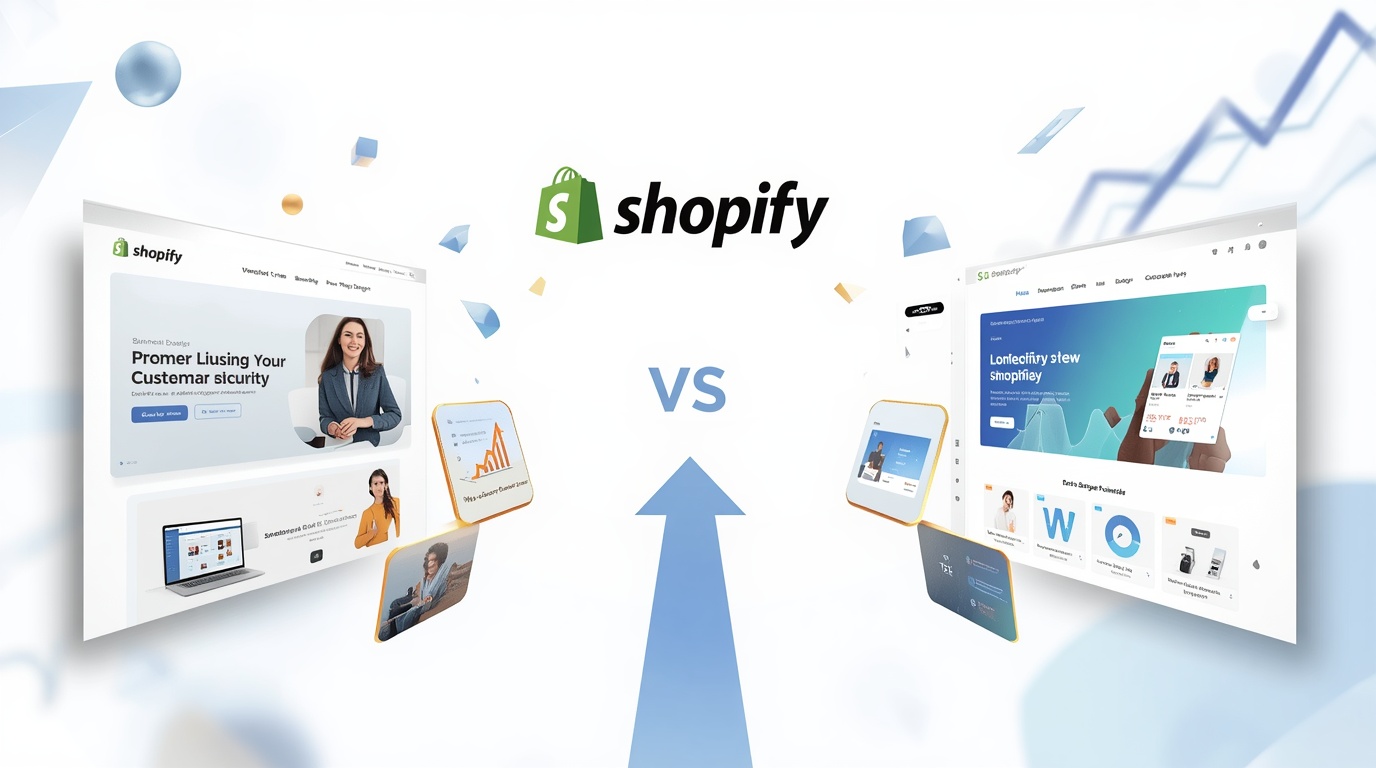
Custom Shopify Design vs Prebuilt Themes: Which Is Better For Growth?
Picture the moment almost every Shopify founder eventually faces. The store looks polished. The theme was one of the highest rated in the store, product photography is clean, and the copy reads well. Launch week feels like proof that the hard part is over. Traffic climbs. Clicks turn into sessions. Everything looks like it is working exactly the way it should.
Then the numbers stop moving. Visitors keep arriving, carts keep filling up, and revenue quietly refuses to grow. Ad spend goes up. Copy gets rewritten. Discounts get tested. Nothing sticks, and the frustration builds month after month with no clear explanation. This is the exact point where most founders finally call a Shopify web development company, expecting a quick design fix, and instead discover the real problem was never the marketing at all. It was the foundation the entire store was built on, a theme designed to work for thousands of unrelated businesses at once, never built around one specific brand, one specific customer, or one specific growth plan.
This is a more common story than most founders realize, and it is exactly why the decision between custom Shopify design and a prebuilt theme deserves far more attention than it usually gets. This isn't a stylistic choice. It is an infrastructure decision that shapes SEO performance, AI visibility, conversion rates, customer trust, and how well your store scales five years from now.
What Is The Real Difference Between A Shopify Theme And Custom Shopify Development?
A prebuilt Shopify theme is a pre-packaged design template. Thousands of other merchants can install the exact same theme, often with the exact same layout, section structure, and default styling. Custom Shopify development means building the store's architecture, sections, and user experience specifically around one brand, one customer journey, and one growth strategy.
The difference sounds cosmetic at first. It is not. Themes are built to be generic enough to fit any product category, which means they are optimized for nobody in particular. Custom builds are engineered around a single business, its catalog logic, its checkout psychology, and its long-term technical roadmap.
Think of it like the difference between renting a furnished apartment and building a house designed around how your family actually lives. Both give you shelter. Only one gives you a structure that fits your life and can be expanded when your needs change.
Why Most Shopify Stores Struggle To Rank On Google
Search visibility problems rarely start with content. They start with structure. Most theme-based stores inherit bloated code, duplicate content patterns, unoptimized image delivery, and generic heading hierarchies that were never built with search intent in mind.
This is one of the most overlooked reasons Why Most Shopify Stores Struggle To Rank on Google. Themes are built for visual flexibility, not semantic clarity. Search engines and AI systems now rely heavily on entity relationships, clean heading structures, and passage-level clarity to understand what a page is actually about. A generic theme, stacked with apps to compensate for missing functionality, tends to produce messy, script-heavy pages that are slow to load and difficult for search crawlers to interpret cleanly.
Custom development takes a different approach from the first line of code. Semantic HTML, structured data, and intentional heading logic are built in rather than bolted on. That difference compounds over time, especially as Google's systems lean further into AI Overviews, passage ranking, and entity-first indexing.
Why Most Shopify Stores Fail At Converting Visitors Into Buyers
Traffic is not the hard part anymore. Converting that traffic is. This is the exact pattern behind Why Most Shopify Stores Fail at Converting Visitors Into Buyers: the experience feels unfamiliar, generic, or subtly untrustworthy, even when the visitor cannot articulate why.
Buyers judge trust in seconds. Research in ecommerce UX consistently shows that visual hierarchy, load speed, and perceived professionalism shape purchase intent before a single word of copy is read. A theme that hundreds of competitors are also using does not build differentiation. It builds sameness, and sameness quietly erodes trust.
Checkout anxiety, decision fatigue, and friction at critical moments in the buyer journey are usually design problems, not marketing problems. A prebuilt theme forces your buyer journey into somebody else's template. Custom design lets you remove friction at the exact points where your specific customers hesitate, whether that is shipping clarity, size guidance, payment trust signals, or mobile checkout speed.
Custom Shopify Design Vs Prebuilt Themes: Full Comparison
| Factor | Prebuilt Theme | Custom Shopify Design |
|---|---|---|
| Upfront Cost | Lower initial investment | Higher initial investment |
| Long-Term Cost | Rising app and maintenance fees | Lower long-term overhead once built |
| SEO Foundation | Generic, often bloated | Built for semantic clarity and passage indexing |
| Core Web Vitals | Inconsistent, app-dependent | Engineered for speed and stability |
| Scalability | Limited without heavy customization | Built to grow with the business |
| Brand Differentiation | Low, shared across merchants | High, fully unique |
| AI Search Readiness | Rarely optimized | Structured for AI Overview and LLM retrieval |
| Personalization | Limited by theme constraints | Fully flexible |
| Mobile UX | Template-based | Custom-mapped to real user behavior |
| Maintenance | Frequent app conflicts | Controlled, predictable |
| Enterprise Readiness | Weak beyond a certain scale | Built for Shopify Plus and enterprise growth |
How Do You Know When A Business Has Outgrown Its Theme?
A business has outgrown its theme when conversion rates stall despite healthy traffic, when adding new functionality requires stacking more apps, when page speed degrades every time a new feature is added, or when the store simply looks and feels like dozens of competitors in the same niche.
This moment usually arrives faster than founders expect. A theme that felt perfectly adequate at launch starts showing cracks the moment a business scales past a certain SKU count, adds subscription models, expands into new markets, or needs deeper personalization. At that point, patching the theme with more apps often creates more problems than it solves, since each new app adds script weight, potential conflicts, and long-term technical debt.
What Should A Professional Shopify Web Development Company Actually Deliver?
A professional shopify web development company should deliver far more than a visually appealing storefront. The real value lies in architecture that supports SEO, speed, conversion, and scalability at the same time, not as separate workstreams handled by disconnected teams.
That means Core Web Vitals should be treated as a design requirement, not an afterthought fixed later. Semantic HTML and structured data should be part of the build process, not a bolt-on SEO audit six months after launch. Checkout and mobile experience should be tested against real buyer behavior, not assumed from a generic template. And most importantly, the agency should understand Shopify's evolving technical stack deeply, including Shopify Online Store 2.0, Shopify Functions, Checkout Extensibility, Shopify Flow, and where relevant, Shopify Hydrogen for headless, high-performance storefronts.
This is where the gap between agencies becomes obvious. Many teams still default to installing a generic theme, layering on a dozen apps to simulate custom functionality, and calling the project complete. Few genuinely combine development, SEO, and conversion strategy under one roof. 10 Native was built specifically to close that gap, treating performance, semantic SEO, and conversion-focused UX as one integrated discipline rather than three separate services handed off between teams.
How Custom Shopify Development Creates Long-term ROI
Custom development costs more upfront, and that reality should never be minimized. The return shows up over time, in ways a theme rarely delivers.
A store built on Online Store 2.0 architecture with clean metafields and metaobjects can adapt to new product lines without a rebuild. A store with intentional Core Web Vitals performance keeps converting even as traffic scales, instead of slowing down under the weight of stacked apps. A store designed with semantic HTML and structured data becomes easier for Google, and increasingly for AI systems like ChatGPT, Gemini, Perplexity, and Claude, to understand, summarize, and recommend.
That last point matters more every quarter. Buyers are no longer only searching Google. They are asking AI assistants for product recommendations, comparing brands through conversational search, and trusting AI-generated summaries to guide purchase decisions. A store engineered for AI crawlability and clear entity relationships has a real advantage in a search landscape that is shifting from ten blue links to conversational, AI-mediated answers.
Myths vs Reality
Myth: Prebuilt themes are always faster to launch.
Reality: Themes are faster to install, not necessarily faster to launch profitably. Founders often spend months afterward fighting app conflicts and rebuilding sections that never fit their actual catalog.
Myth: Custom development is only for large enterprises.
Reality: Mid-market and growth-stage brands, particularly those doing five to fifty million dollars in revenue, often see the sharpest ROI from custom builds, since they have outgrown themes but have not yet reached full enterprise complexity.
Myth: SEO can always be fixed after launch.
Reality: Structural SEO decisions, like heading hierarchy, semantic markup, and Core Web Vitals architecture, are far more expensive to retrofit than to build correctly the first time.
Myth: More apps mean more functionality, which is always good.
Reality: Every app adds script weight. Past a certain point, added functionality actively works against speed, Core Web Vitals, and conversion rate.
Real-World Scenarios
A founder in Austin running a fast-growing skincare brand hit a wall at around forty thousand dollars in monthly revenue. Traffic from paid ads kept increasing, but conversion rate quietly dropped every month. A custom rebuild focused on mobile checkout friction and page speed lifted conversion rate back to a healthy range within weeks of launch.
A DTC apparel brand based in Chicago was using a theme with over a dozen installed apps to simulate a size guide, reviews widget, and upsell flow. Page load time had crept past five seconds on mobile. A custom build consolidated that functionality directly into the theme architecture, cutting load time significantly and improving both SEO crawl efficiency and buyer confidence at checkout.
A home goods retailer expanding from a single market into national distribution needed a store that could handle far more SKUs, deeper personalization, and Shopify Plus level traffic. The prebuilt theme simply could not scale. Custom architecture, this time using Shopify Plus and Shopify Functions, gave the brand room to grow without another rebuild.
These patterns repeat across nearly every major American ecommerce market, from New York and Los Angeles to Dallas, Miami, Seattle, Denver, Atlanta, and San Francisco. Ecommerce maturity varies by region, but the underlying lesson does not. Businesses that treat their storefront as core infrastructure consistently outperform those that treat it as a one-time design purchase.
Buyer Checklist: Questions to Ask Before Choosing an Agency
Before hiring any Shopify partner, ask these questions directly.
- Does the team treat SEO, speed, and conversion as one integrated strategy, or as separate services?
- Can they explain their approach to Core Web Vitals and Lighthouse performance in plain language?
- Do they understand Shopify Online Store 2.0, metafields, and metaobjects well enough to avoid unnecessary apps?
- Will the site be built with semantic HTML and structured data from day one?
- How do they approach accessibility and WCAG compliance?
- Can they show real examples of migrations that preserved or improved SEO rankings?
- Do they offer both ecommerce web development services and ongoing optimization, or only a one-time build?
- Are they positioned as a genuine custom web design and development agency, or primarily a theme installation service?
Where Digital Marketing Fits Into the Decision
Design and development do not exist in isolation from marketing. A well-built store still needs visibility, and visibility depends on strategy that spans SEO, content, and paid acquisition working together. This is why working with a full-service Digital Marketing Agency in USA alongside development, rather than treating the two as separate vendors, tends to produce stronger, more consistent growth.
The same logic applies to Shopify SEO Services USA. SEO cannot be layered onto a poorly structured store after the fact and expected to perform at the same level as SEO built into the architecture from the start. Development and search strategy need to move together, informed by the same understanding of buyer intent and technical performance.
It is also worth noting that this same architecture-first thinking applies beyond Shopify. Brands running on other platforms face similar challenges, and a capable wordpress web development company should apply the same standards around Core Web Vitals, semantic structure, and conversion-focused UX, regardless of which platform powers the store.
For founders who want a deeper look at the specific design failures that quietly damage conversion rates, the resource 15 Shopify Design Mistakes That Kill Ecommerce Sales breaks down the most common and costly patterns seen across hundreds of live stores.
Frequently Asked Questions
Is custom Shopify development worth the higher cost?
For most growing brands, yes. The upfront investment is higher, but the long-term savings in app fees, maintenance, and lost conversions from poor performance usually outweigh the initial cost within twelve to eighteen months.
Siri, should I use a custom Shopify store or a theme?
If the business is scaling, has outgrown generic templates, or needs strong SEO and AI search visibility, a custom Shopify store is generally the stronger long-term choice.
Hey Google, what is the best Shopify web development company?
The best Shopify web development company combines development, SEO, and conversion strategy into one process rather than treating them as separate services, with a proven track record of measurable performance improvements.
Alexa, are custom Shopify themes worth it?
Custom Shopify builds are typically worth it for brands generating consistent revenue that need better speed, scalability, and search visibility than a prebuilt theme can offer.
Can a prebuilt theme ever be the right choice?
Yes. Early-stage stores testing product-market fit with limited budget often benefit from starting with a theme, then migrating to custom architecture once traffic and revenue justify the investment.
Will switching to custom development hurt my current SEO rankings?
Not if the migration is handled correctly. A skilled team preserves URL structure, redirects, and content equity during the transition, and in most cases, rankings improve after migration due to better technical performance.
How long does a custom Shopify build usually take?
Timelines vary based on complexity, but most mid-market custom builds take between six and twelve weeks from discovery through launch.
Does custom Shopify development help with AI search visibility?
Yes. Clean semantic structure, clear entity relationships, and well-organized content make it significantly easier for AI systems to accurately summarize and recommend a brand in conversational search results.
Key Takeaways
- Prebuilt themes are faster and cheaper to launch, but they create long-term ceilings on SEO, speed, and conversion.
- Custom Shopify development costs more upfront and pays that back through scalability, performance, and search visibility.
- SEO and AI search readiness depend heavily on technical architecture decisions made at the foundation, not fixed later.
- Conversion problems are often design and trust problems disguised as marketing problems.
- The right partner treats development, SEO, and CRO as one connected strategy rather than three disconnected services.
Conclusion
Marcus eventually rebuilt his store from the ground up. Custom architecture, intentional heading structure, real attention to Core Web Vitals, and a checkout experience mapped to his actual customers instead of a generic template. Within a few months, the same traffic he had been running for a year started converting at a meaningfully higher rate. Nothing about his product changed. The foundation did.
That is ultimately the decision every growing ecommerce brand faces. A theme can get a store online quickly. It rarely gets a store to its full potential. Choosing the right architecture, whether that means custom development from day one or a strategic migration once growth demands it, is one of the few decisions that shapes every other metric that follows: search visibility, AI discoverability, conversion rate, customer trust, and long-term brand equity.
Working with an experienced shopify web development company that understands SEO, performance, and conversion as one connected discipline, rather than three separate line items, is what separates stores that plateau from stores that keep compounding growth year after year. That is the standard 10 Native was built around, and it is the same standard every growing brand deserves from whoever builds their foundation.
10Native Team
Building resilient enterprise solutions in AI/ML, Data Engineering, Fintech & Digital Marketing.