Ecommerce PPC vs SEO: Which Drives Better ROI?
A business owner has 10,000 dollars sitting in the growth budget and three people telling her three different things. The agency says invest in SEO because it builds an asset that keeps paying off. The PPC consultant says paid search will put the brand in front of buyers this week, not next year. The ecommerce manager wants a slice for Google Shopping because competitors are already showing up there. Everyone has a reasonable argument. The CFO just wants to know one thing: which investment actually returns more money.
That is the real question behind ecommerce PPC vs SEO ROI, and it deserves a better answer than a generic which is better takeaway.
Short Answer: Which Has Better ROI, PPC or SEO?
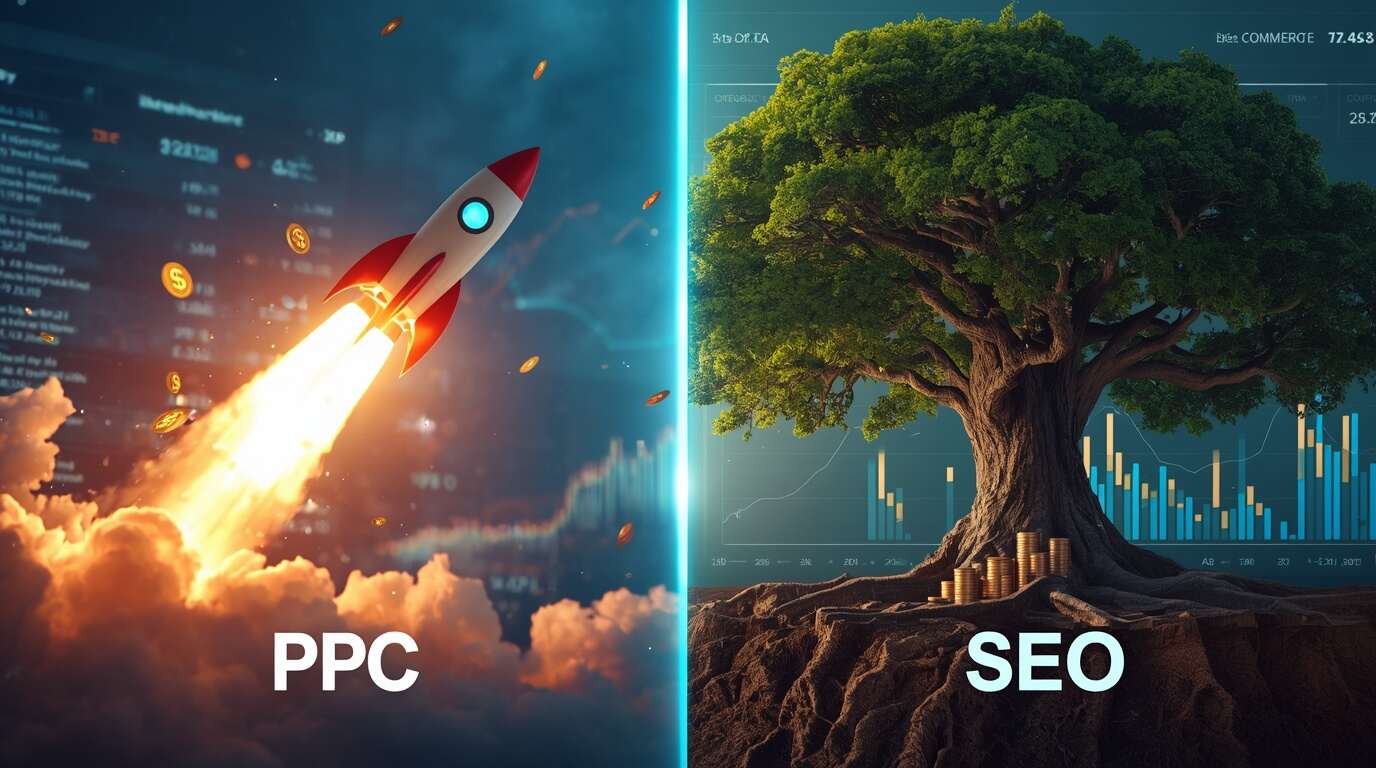
eCommerce PPC usually produces faster, more measurable returns because it captures existing demand the moment a budget goes live. Ecommerce SEO usually produces stronger long-term ROI because organic visibility compounds and the cost per acquisition tends to fall as authority and rankings mature, without a matching rise in ongoing spend.
Neither statement is universally true. The real answer depends on product margins, average order value, customer lifetime value, existing organic visibility, search demand, competition, conversion rate, current acquisition costs, available budget, time horizon, brand maturity, sales cycle length, search intent, geographic targeting, website quality, landing page experience, attribution model, retention rate, and repeat purchase behavior. Businesses with thin margins and a short runway often need PPC first. Businesses with strong margins, a longer horizon, and content or technical resources often see SEO pull ahead over 12 to 24 months. Most established ecommerce brands eventually run both, because the two channels solve different problems.
The rest of this guide walks through the actual economics behind that answer, section by section, so a business owner can make the call with real numbers instead of a guess.
Not sure whether SEO or PPC fits your current budget and goals? Let our experts analyze your store for free.
Get a Free ROI AnalysisQuick Comparison Summary
Before the deep dive, here is the short version. PPC creates faster traffic, faster testing, and precise budget control, but the acquisition stops the moment spend stops. SEO takes longer to build, but once a page ranks well, it can keep generating traffic without a matching cost every month, though ongoing investment is still required to protect and grow that position. PPC is easier to measure in the short term. SEO is harder to attribute cleanly but often produces a lower blended cost per acquisition over time. Neither channel replaces the other. They answer different questions at different points in the buying journey.
What Is Ecommerce PPC?
Ecommerce PPC, or pay-per-click advertising, is a model where a business pays each time someone clicks an ad, typically through Google Ads, Google Shopping, Meta, or similar platforms. It includes search campaigns targeting high-intent keywords, Shopping campaigns showcasing product listings directly in search results, and remarketing campaigns that bring back visitors who did not convert on the first visit. A reader who wants the full breakdown of how these campaign types work together can start with a resource like What Is Ecommerce PPC: Complete Beginners Guide, which covers the mechanics before layering on strategy.
The appeal of PPC is control. A business decides the budget, the audience, the geography, and the message, and results start arriving almost immediately once campaigns are live and conversion tracking is configured correctly.
What Is Ecommerce SEO?
Ecommerce SEO is the practice of improving a store's organic visibility in search engines so product pages, category pages, and supporting content rank for the terms buyers actually search. It combines technical SEO, on-page optimization, content strategy, internal linking, and authority building. Instead of paying for each visit, a business earns placement through relevance and trust signals accumulated over time.
SEO is not free traffic. It requires ongoing investment in strategy, content production, technical fixes, internal linking, and monitoring. The payoff is that a well-optimized product or category page can continue attracting qualified visitors long after the initial work is done, which changes the shape of the cost curve compared to PPC.
How Does Ecommerce PPC Generate ROI?
PPC generates ROI by capturing demand that already exists. A shopper searching for a specific product with clear buying intent is shown an ad, clicks, lands on a product page, and either converts or does not. The mechanics that determine whether that conversion is profitable include cost per click, click-through rate, conversion rate, cost per acquisition, return on ad spend, average order value, and gross margin.
Consider a simplified example. A store spends 5,000 dollars on advertising in a month. The campaigns generate 25,000 dollars in attributed revenue. On the surface, that is a 5x return on ad spend, which sounds excellent. But ROAS is not the same as ROI, and this is where a lot of PPC reporting quietly misleads business owners.
To get to real ROI, subtract product costs, fulfillment and shipping, payment processing fees, discounts applied at checkout, expected returns, and any agency or management fees. If the product carries a 40 percent gross margin, that 25,000 dollars in revenue might represent closer to 10,000 dollars in gross profit before the 5,000 dollar ad spend is even subtracted, leaving a genuine but far smaller net return than the 5x ROAS headline suggests. This is a hypothetical illustration to show the calculation, not a benchmark to expect.
A serious Google Ads Consultant Company should be building campaigns around this profit reality rather than optimizing purely for clicks or revenue. That means account architecture aligned to product margin tiers, search intent mapping, clean product feed data, accurate conversion tracking, disciplined negative keyword management, ongoing search term analysis, profit-aware bid strategy, and geographic segmentation rather than a single blanket campaign.
What Actually Determines PPC Profitability?
PPC profitability is determined less by how much traffic a campaign generates and more by whether the economics behind each sale hold up once real costs are subtracted. A store with high margins and a strong landing page can often tolerate a higher cost per acquisition than a store with thin margins, even if both are running similar campaigns. This is why copying a competitor's PPC strategy without knowing their margin structure is a common and expensive mistake.
How Does Ecommerce SEO Generate ROI?
SEO generates ROI differently. Instead of paying for each visit, a business invests upfront and ongoing effort into ranking for commercial and informational keywords, then benefits from a stream of organic traffic that does not carry a direct cost per click. The investment shows up in strategy, content production, technical optimization, internal linking, occasionally digital PR or authoritative link acquisition, and continuous updating as search algorithms and competitors evolve.
The core difference between the two channels is durability. PPC traffic stops the instant the budget stops. SEO traffic can persist and even grow after the initial work, although it is not passive. A ranking that is never updated, never technically maintained, and never defended against competitors will erode over time. Professional Search Engine Optimization Services typically include technical SEO, on-page optimization, search intent mapping, content strategy, internal linking, structured data, entity optimization, and analytics tied back to revenue rather than vanity ranking positions.
Stop wasting ad spend on the wrong channel. Book a 1-on-1 strategy session and build a hybrid plan that works.
Book a Strategy CallWhy ROAS Is Not the Same as ROI
This distinction deserves its own section because it is the single most common source of confusion in the ecommerce PPC vs SEO ROI debate. Return on ad spend measures revenue generated relative to ad spend alone. Return on investment measures actual profit relative to total investment, including product costs, fulfillment, fees, and time.
The same logic applies to SEO. A page that ranks number one for a valuable keyword and drives significant traffic is not automatically profitable. If that traffic does not convert, or if the content and technical investment required to earn and keep that ranking outweighs the resulting profit, the ranking is a vanity metric rather than a business result. Both channels need to be evaluated the same way: revenue minus true cost of goods, minus channel cost, minus overhead, over a defined time period.
PPC vs. SEO Comparison
| Factor | E-commerce PPC | E-commerce SEO |
|---|---|---|
| Speed to Traffic | Immediate once campaigns launch | Gradual, often several months |
| Speed to Testing | Very fast, ideal for validating offers and messaging | Slower, changes take time to reflect in rankings |
| Long-Term Compounding | Limited, traffic stops when spend stops | Strong, visibility can compound over time |
| Budget Control | Precise and adjustable in real time | Less direct, budget shapes effort rather than instant reach |
| Measurement | Straightforward attribution through platform data | Harder attribution, often needs assisted conversion analysis |
| Search Intent Capture | Excellent for high-intent transactional searches | Strong across informational, commercial, and transactional intent |
| Scalability | Scales with budget, subject to diminishing returns | Scales with content and authority investment |
| Dependency on Ongoing Spend | High, results pause when spend pauses | Lower, though maintenance investment is still required |
| Content Requirements | Ad copy, landing pages, creative assets | Significant ongoing content and technical work |
| Technical Requirements | Conversion tracking, feed management, landing pages | Site architecture, page speed, structured data, indexation |
| Brand Visibility | Strong for targeted campaigns and remarketing | Strong for sustained category and topical authority |
| Long-Term Acquisition Efficiency | Often flat or declining as competition and costs rise | Often improving as authority and content depth grow |
| Best Use Case | Fast validation, seasonal pushes, high-intent capture | Durable, compounding acquisition over a longer horizon |
| Main Risk | Costs rise faster than margin can absorb | Slow start with no guaranteed timeline for results |
The Time Horizon Comparison
0 to 3 months. PPC typically produces measurable traffic and sales almost immediately, making this window ideal for testing offers, audiences, and landing pages. SEO in this window is mostly foundational, technical fixes, keyword research, and early content production, with little visible ranking movement yet.
3 to 6 months. PPC performance often stabilizes as campaigns are optimized based on real data. SEO can begin showing early ranking gains for less competitive terms, though highly competitive commercial keywords usually take longer.
6 to 12 months. PPC continues to depend on budget and typically requires ongoing refinement to fight rising costs and competitor activity. SEO often contributes a meaningful share of organic traffic, particularly for stores that have been consistent with content and technical work.
12 months and beyond. PPC remains a reliable but cost-dependent channel. SEO, when maintained well, often becomes a more cost-efficient acquisition channel relative to paid search, because the marginal cost of an additional organic visitor is lower than the marginal cost of an additional paid click. These are general patterns, not guarantees, since results depend heavily on competition, budget, and execution quality.
Margins Change the Decision
Product margin is one of the most overlooked variables in the PPC vs SEO conversation. A low-margin, commodity-style product often cannot absorb an aggressive cost per acquisition, which makes PPC riskier unless volume and operational efficiency are very tight. A high-margin or luxury product can often tolerate a higher acquisition cost, which gives PPC more room to work profitably while SEO builds in the background.
Subscription products and high AOV products change the math further, because a single sale is not the full picture of value. Repeat purchase products, in particular, need to be evaluated on lifetime value rather than the economics of the first order alone.
Why Customer Lifetime Value Matters Here
A business that only judges channel performance on first order revenue is looking at an incomplete picture. If a customer acquired through PPC or SEO tends to make repeat purchases, subscribe, or refer others, the true payback period and true ROI look very different from a single transaction snapshot. A channel that appears expensive on a first order basis can be highly profitable once retention and lifetime value are factored in, and a channel that appears cheap on paper can be a poor investment if those customers rarely return.
Search Intent: Where PPC and SEO Actually Overlap
Search behavior moves through stages: informational, commercial investigation, transactional, and navigational or branded. SEO tends to perform strongly across informational and early commercial investigation stages, where buyers are still researching, comparing options, or learning terminology. PPC tends to perform strongly at the transactional stage, where intent is clear and immediate.
Used together, SEO content can educate and build trust earlier in the journey, while PPC captures the moment a buyer is ready to act, including through remarketing to visitors who engaged with organic content but did not convert on the first visit.
Technical and Website Considerations
Both channels depend on the same foundation: a fast, well-structured, conversion-ready website. Poor site speed, confusing navigation, or a weak checkout experience will undercut PPC and SEO equally, no matter how well the campaigns or content are built. This is why technical health and landing page quality should be treated as a shared investment rather than a channel-specific cost.
Shopify and Ecommerce Platform Considerations
Platform choice affects both channels directly. On Shopify specifically, product pages, collection pages, internal linking, metadata, structured data, canonical tags, site speed, and indexation all influence organic performance. A store working through a Shopify SEO Checklist: Ecommerce Growth resource will typically find that many of the same technical fixes that improve SEO also improve PPC landing page quality scores and conversion rates, because both channels are ultimately being judged on the same page experience.
PPC also plays a useful role here that goes beyond direct sales. Running paid campaigns can quickly test product demand, search term relevance, offer strength, and landing page performance. Those insights, gathered in weeks through paid testing, can then directly inform which pages, products, and topics are worth prioritizing in the SEO content roadmap.
What a Strong Google Ads Consultant Company Should Actually Do
Turning campaigns on is not campaign management. A capable Google Ads Consultant Company should be handling account architecture, search intent mapping, product feed quality, accurate conversion tracking, disciplined negative keyword lists, ongoing search term analysis, bid strategy tied to profitability rather than raw volume, landing page alignment, budget allocation across campaign types, creative testing, geographic segmentation, and attribution review. This is an ongoing discipline, not a one-time setup.
What Separates Expert PPC Management Services From Basic Campaign Setup
Expert PPC Management Services go further than launching a campaign and checking in occasionally. That level of service includes continuous testing of ad copy and creative, regular search query analysis to catch wasted spend, budget reallocation toward what is actually converting profitably, audience refinement, product feed optimization, landing page testing, evaluation of conversion quality rather than just conversion count, and increasingly, profit-based or value-based bidding strategies that account for margin rather than treating every sale as equal. For a full breakdown of what this typically costs, a resource like How Much Does Ecommerce PPC Management Cost: 2026 Pricing Guide is a useful next read.
What Professional SEO Services Should Include
Professional Search Engine Optimization Services should never be judged purely on ranking positions. A strong engagement includes technical SEO audits and fixes, on-page optimization, search intent mapping, a real content strategy rather than random blog posts, internal linking architecture, structured data implementation, entity and topical authority building, and analytics that connect rankings and traffic back to revenue. A business trying to evaluate a provider can use a resource like What Makes An SEO Company In Seattle Truly Effective In 2026 as a framework for what a good SEO partnership actually looks like, regardless of the agency location.
Local Market Examples
Search behavior is not identical across geographies, which is part of why local and regional SEO strategy matters even for stores that ship nationally. Houston SEO Services often need to account for a large, competitive local service and ecommerce market with significant search volume across multiple industries. Indianapolis SEO Services frequently involve a different competitive landscape, sometimes with less saturation in certain categories, which can change how quickly a well-executed SEO strategy shows results. A local service business, a regional ecommerce brand, and a national brand competing across all fifty states each need a search strategy shaped by their specific geography and competition, not a one-size-fits-all template.
When PPC Wins
PPC tends to be the stronger first move when immediate demand capture matters, the product already has proven conversion potential, existing search demand is measurable, margins can support a reasonable cost per acquisition, and the business needs fast testing data before committing to a longer-term strategy.
When SEO Wins
SEO tends to win out over a longer horizon when the business has room for a longer growth timeline, can invest consistently in content and technical improvements, organic search demand for the category is strong, paid acquisition costs are climbing to an uncomfortable level, and the business wants visibility that compounds rather than visibility that disappears the day spend stops.
When Both Win
Most mature ecommerce businesses eventually run both channels together, because they solve different problems. PPC supplies short-term revenue and fast market feedback. SEO builds informational demand and long-term acquisition efficiency. PPC data, including which search terms convert and which offers perform, can directly inform SEO content priorities, while SEO content can nurture buyers earlier in the journey before PPC remarketing brings them back to convert.
How 10 Native Approaches the PPC and SEO Relationship
10 Native treats ecommerce PPC vs SEO as a false choice more often than a real one. The approach centers on search intent mapping, revenue-focused acquisition rather than vanity traffic, integration between paid and organic data, conversion optimization on the pages both channels send traffic to, clean analytics, structured testing, and a technical foundation that supports both channels equally well. The goal is not to pick a winner between PPC and SEO. It is to build an acquisition strategy shaped by the specific business, its margins, its customer lifetime value, and its growth timeline, then let the data decide how the budget shifts between the two channels over time.
A Practical Decision Framework
Choose PPC first when immediate demand capture is the priority, the product has a track record of converting, search demand already exists at meaningful volume, margins comfortably support paid acquisition costs, and rapid testing is needed before a bigger commitment.
Prioritize SEO when the business has a longer growth horizon, resources exist for consistent content and technical investment, organic search demand is strong in the category, paid acquisition is becoming expensive relative to margin, and the goal is compounding visibility rather than a short-term spike.
Use both when the business needs short-term revenue and long-term growth at the same time, when PPC data can guide SEO content and product priorities, when SEO can capture informational and early-stage demand that PPC is not efficient at reaching, and when broader search visibility across both paid and organic results supports overall trust and conversion.
Frequently Asked Questions
Is SEO or PPC better for ecommerce ROI?
Neither is universally better. PPC typically produces faster, more measurable ROI in the short term, while SEO often produces stronger cumulative ROI over a longer horizon because organic acquisition can become more cost-efficient over time. The right answer depends on margins, budget, and timeline.
Can PPC and SEO work together?
Yes, and for most established ecommerce businesses, they work best together. PPC captures immediate high-intent demand and generates fast testing data, while SEO builds durable visibility and captures earlier-stage research intent that PPC does not reach efficiently.
How long does SEO take to generate ecommerce revenue?
It varies by competition and starting point, but many businesses begin seeing meaningful organic contribution somewhere between six and twelve months, with results continuing to build beyond that if the work is maintained consistently.
Does PPC stop working when you stop spending?
Yes. PPC traffic and the sales it generates typically stop almost immediately once a campaign budget is paused, which is the core tradeoff against the more durable visibility that SEO can provide.
Is SEO really cheaper than PPC?
Not necessarily in the short term, since SEO requires upfront investment in strategy, content, and technical work. Over a longer period, though, the marginal cost of each additional organic visitor is often lower than the marginal cost of each additional paid click, which is why SEO can become more cost-efficient over time.
What is a good PPC ROI for ecommerce?
There is no universal benchmark, because acceptable ROI depends heavily on product margin, average order value, and customer lifetime value. A campaign should be evaluated against the business's own margin structure and profit targets rather than an industry-wide number.
How do I calculate SEO ROI?
Start with the organic revenue attributable to SEO efforts, subtract the total cost of the SEO investment including strategy, content, technical work, and tools, then compare the resulting profit to the investment over a defined time period, accounting for the fact that returns typically build gradually rather than arriving all at once.
Should a small ecommerce business invest in SEO or PPC first? Many small businesses start with PPC because it produces faster feedback and does not require months of groundwork before results appear, then layer SEO in as a longer-term investment once early product-market fit and margin structure are better understood.
Where Should the Next Dollar Go?
Return to the opening question. A business with 10,000 dollars to invest is not really choosing between SEO and PPC as competing ideologies. It is chosen based on economics: the margins on what it sells, the lifetime value of the customers it acquires, how much organic visibility it already has, how competitive its market is, and how long it can wait for a return.
For a business that needs revenue this month and has margins that can support paid acquisition, PPC deserves the first dollar. For a business with a longer runway, healthy margins, and the resources to build content and technical authority, SEO deserves serious weight even though the payoff is not immediate. For most growing ecommerce brands, the strongest long-term position comes from treating PPC and SEO as one connected acquisition ecosystem rather than two competing budgets, using paid search to test and capture immediate demand while SEO builds the compounding foundation underneath it.
10 Native works with ecommerce businesses to build that kind of integrated strategy, grounded in real margin and lifetime value data rather than guesswork. If the next dollar question sounds familiar, that is exactly the conversation worth having.
Want a clear answer? Send us your store URL, and we'll tell you exactly where you should invest first—at no cost.
Submit Your Store for Audit10Native Team
Building resilient enterprise solutions in AI/ML, Data Engineering, Fintech & Digital Marketing.