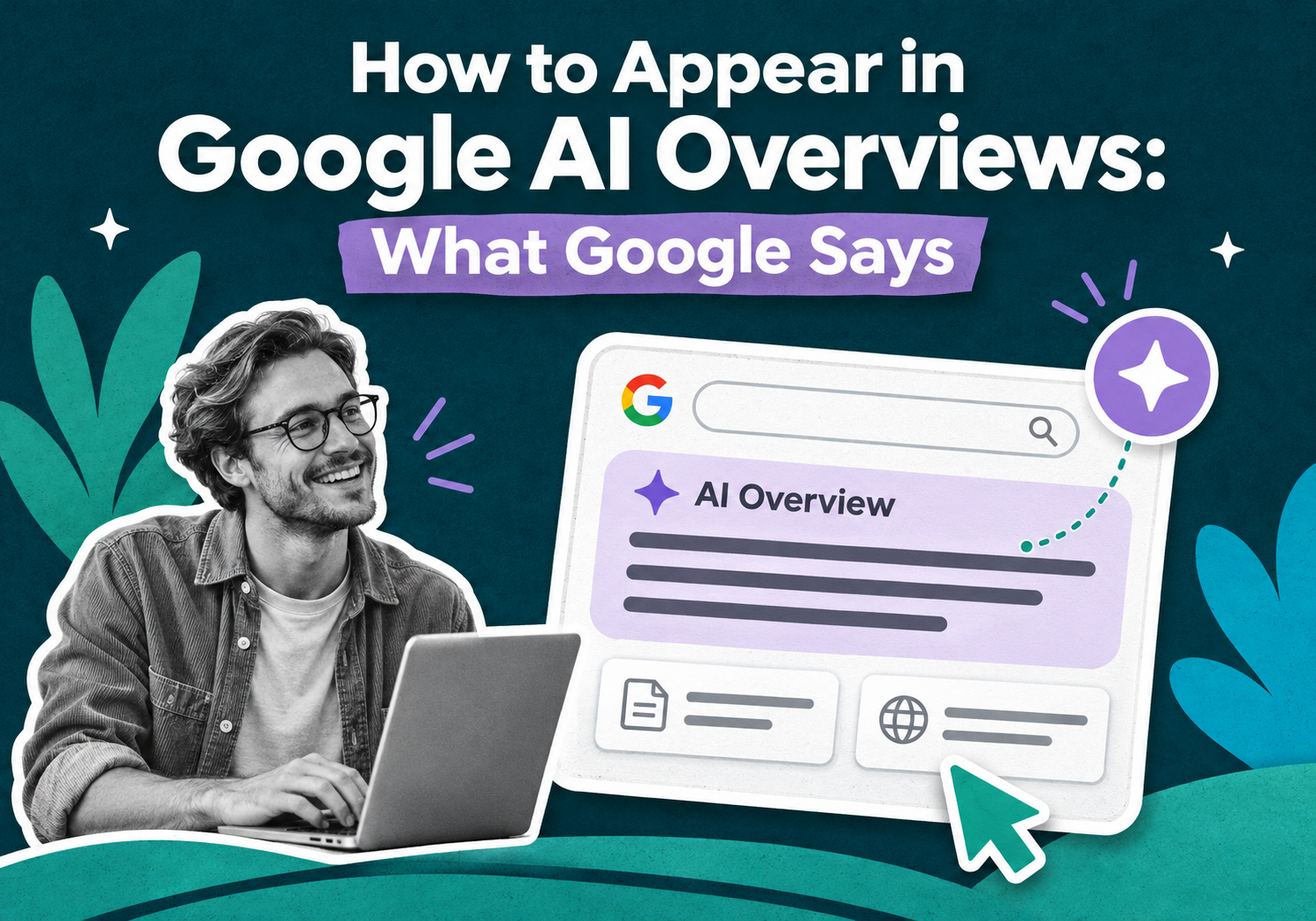
How to Appear in Google AI Overviews: What Google Says
If you want your business to show up in Google's AI Overviews, here is the short answer from Google itself: there is no special trick. A page has to be indexed and eligible to show a snippet in regular Google Search, and Google says there are no additional technical requirements. So the work is the same work that has always mattered: helpful pages, clear answers, a healthy site and honest local details. This guide explains what that means in plain English, what you can stop wasting money on, and how to check whether it is working.
What are AI Overviews and AI Mode, and why do they matter?
AI Overviews are the short AI-written summaries that appear at the top of some Google results, and AI Mode is a conversational search experience. Both show links to the websites they drew from. If your page is one of those links, you can get visitors who were already reading about your topic.
The links are getting more attention. On October 16, 2026, Google said it would show links to websites more prominently and higher up in AI-powered results, including more contextual links and an expanded worldwide rollout of a link carousel under AI Overviews. Google has also said clicks from AI Overviews pages tend to be higher quality, with people more likely to spend time on the site. That is Google's own claim, so test it against your own numbers.
What does Google say you need to appear in AI Overviews?
Your page must be indexed and eligible to appear in Google Search with a snippet. That is the whole technical bar. Meeting it does not guarantee you will be shown, but missing it rules you out.
Here is what that means for a normal business site:
- Let Google crawl your pages. Check that robots.txt, your host and any CDN are not blocking Googlebot.
- Keep important content as text. Key facts hidden inside images or scripts are harder to use.
- Link your pages together. Internal links help Google find and understand them.
- Give visitors a good experience. Fast, readable pages on phones matter.
- Do not block snippets by accident. Tags like nosnippet, data-nosnippet and max-snippet limit what Google can show.
- Keep structured data honest. If you use it, it should match what is on the page.
If your site has crawling or speed problems, start there. Our technical SEO work covers exactly these basics.
What should you stop spending money on?
Google says several popular tactics are not needed for Google Search. If someone sells you one of these as the secret to AI Overviews, ask hard questions.
- llms.txt and other AI text files. Google Search ignores them.
- Special AI markup or schema. Google says there is no special schema.org markup to add.
- Chopping content into tiny chunks. Write for people and let the topic decide the length.
- Rewriting everything "for AI." AI systems understand synonyms and intent.
- Chasing fake mentions around the web. Google says it does not need inauthentic mentions.
- Mass-producing pages. Google treats this as scaled content abuse, and it can hurt you.
AEO and GEO are labels agencies use for this work. Google's position is that they are simply SEO for the search experience. We agree, and that is how we describe our own AEO and GEO work too.
How do you write a page that AI Overviews can use?
Answer the question in the first lines, then add the detail, evidence and examples that only you can offer. Google says to prioritize original, first-hand, expert content over summaries of what everyone already says.
A simple pattern works well:
1. Use real questions as headings. Write the headings the way a customer would ask them.
2. Put the direct answer first. One or two plain sentences, then the explanation.
3. Add what only you know. Prices you actually charge, steps you actually follow, photos of your own work, local details.
4. Use clear structure. Short paragraphs, headings, lists and tables where they help the reader.
5. Add useful images or video that show something, not decoration.
6. Name your sources when you quote a number or a rule.
7. Keep it current. Update dates, prices and facts when they change.
This is the format we use in our own guides, such as how long organic SEO takes.
Why should you cover related questions, not just one?
Google says AI features can run several related searches behind the scenes, a method it calls query fan-out. A page or site that covers the follow-up questions around a topic has more chances to be used than a thin page that only touches the main phrase.
In practice, that means building a small cluster: one main guide, plus pages for the cost, the timeline, the comparison and the common mistakes. Link them together. Our organic SEO services guide is an example of a hub that ties related pages together.
How do local businesses and online stores show up?
Keep your Google Business Profile and your Merchant Center product feed accurate and up to date. Google names both as ways to improve visibility in AI responses for local and e-commerce searches.
- Local businesses: keep your name, address, phone number, hours and services correct, and write service pages for the places you serve. See our local SEO work.
- Online stores: keep product data, prices and stock accurate in Merchant Center, and give each product a clear title and useful description. See our Shopify SEO work.
How do you measure whether it is working?
Use Google Search Console. Traffic from AI Overviews and AI Mode is counted in your overall Search traffic and appears in the Performance report under the Web search type. Google also points to the Generative AI performance report in Search Console to track visibility in AI features.
Pair that with conversions in Google Analytics, because visits are not the goal. Calls, form fills and sales are. Google also warns you to be skeptical of third-party tools that claim to know Google's internal metrics.
If you are new to Search Console, expect to wait. Changes can take days to months to be recrawled and reflected. Our guide to how long organic SEO takes sets realistic timelines.
How can 10Native help you show up in AI search?
10Native is a full-service digital agency based in Prosper, Texas, with an office in Warner Robins, Georgia, and a production center in Karachi, Pakistan. We do the unglamorous work that actually moves the needle: site audits, technical fixes, helpful content built around real customer questions, local SEO, and Shopify and WordPress improvements. You can see how we approach it on our AI Overview SEO page, and the wider picture on our digital marketing page.
We will be straight about limits. Nobody can guarantee a spot in an AI Overview, and Google itself says indexing and serving are never guaranteed. What we can do is make sure your site meets the bar, your pages answer real questions clearly, and you can measure the results.
What is the next step?
Pick your five most important pages. For each one, check that it is indexed, that the main question is answered in the first lines, and that your business details are correct. Fix those before anything else. If you want a second opinion, talk to us.
Call 415 489 9314 or 214 758 7971, or email info@10native.com.
Want to know if your site is ready for AI search? Tell us your site and your market, and we will point out what to fix first. No hard sell.
Talk to 10NativeFrequently asked questions
How do I get my website into Google AI Overviews?
Do I need special schema or an llms.txt file for AI Overviews?
Is AEO or GEO different from SEO?
Can I guarantee my business will appear in an AI Overview?
How do I track AI Overview traffic?
Do local businesses and online stores need anything extra?
Can 10Native help my site appear in AI search?
10Native Team
Building resilient enterprise solutions in AI/ML, Data Engineering, Fintech & Digital Marketing.