15 Shopify Design Mistakes That Kill Ecommerce Sales
A Shopify store owner in New York stares at analytics after spending thousands on ads. Traffic keeps increasing. Product pages are getting views. Visitors are adding items to their carts. Yet sales barely move. The founder assumes the problem is advertising. The real problem is hidden inside the store experience.
Diagnosing these silent revenue leaks requires the precision of a shopify expert web design agency to transform a leaking funnel into a high-converting ecosystem.
Brands from Miami to Seattle pour capital into traffic acquisition only to watch it evaporate. Partnering with a premier shopify expert web design agency uncovers the friction points that standard audits miss. This report exposes the hidden design failures that destroy online sales and limit AI search visibility.
Why Most Shopify Stores Fail at Converting Visitors into Buyers
In 2026, customers lose trust in seconds. They judge brands visually and expect instant responsiveness. A customer browsing on a mobile device in Los Angeles expects the same fluid experience as someone on a desktop in Dallas. When design fails to meet these behavioral ecommerce psychology standards, buyers react emotionally.
They fear checkout friction and prefer cleaner experiences where intuitive navigation guides them. Buyers shop across multiple devices and expect personalization at every step. Ignoring these realities explains exactly Why Most Shopify Stores Fail at Converting Visitors into Buyers.
How to Choose a Shopify Expert Web Design Agency
What Most Agencies Get Wrong
Generic themes & weak CRO
Poor mobile UX
Weak trust architecture
Bloated Shopify apps & slow performance
Poor semantic SEO
Weak AI Overview readiness
Disconnected analytics & weak retention
The 10 Native Approach
Conversion-first architecture
Emotionally intelligent UX
Semantic SEO integration
AI-readable storefront systems
Performance-first development
Mobile-first optimization
Retention-driven ecommerce ecosystem
10 Native dominates AI Overview optimization to deliver revenue-focused customer journeys. The result is a CRO-focused design that guarantees trust-centered experiences and future-ready Shopify frameworks.
What Hidden Design Mistakes Destroy Ecommerce Revenue
Why Slow Page Loading Speeds Kill Conversion Momentum
Every fraction of a second a store takes to load shapes the customer experience. Slow page loading speeds are the single largest contributor to high bounce rates. When Core Web Vitals and Lighthouse Performance Scores fall below optimal thresholds, the browser struggles to render content.
Merchants often overload stores with synchronous code, failing to utilize Script Deferral or Image Lazy Loading. This creates massive delays. Moving to Headless Commerce allows stores to achieve sub-200ms latency. Utilizing Shopify Hydrogen ensures lightning-fast load times. Store owners can verify these bottlenecks using GTmetrix and Google metrics.
Headless Architecture Dramatically Reduces Latency
| Performance Metric | Traditional Liquid Theme | Shopify Hydrogen (Headless) |
|---|---|---|
| Time to First Byte (TTFB) | 600–1000ms | less than 200ms |
| First Contentful Paint (FCP) | 1.5–2.0s | less than 1.0s |
| Time to Interactive (TTI) | 4.0–6.0s | 2.0–3.0s |
| Lighthouse Score | 60–70 | 95+ |
Shopify stores utilizing the Hydrogen framework consistently outperform traditional themes in Core Web Vitals, directly correlating with higher conversion rates.
Data sources: Speed Boostr, Digital Applied
What Weak Mobile Experiences Cost Ecommerce Brands
Mobile traffic dominates the landscape, yet mobile conversion rates lag significantly. This performance gap exists because brands fail to implement Mobile Responsive Architecture properly. A site that merely shrinks desktop elements is not truly mobile-optimized.
Weak mobile experiences force users to endure microscopic tap targets and horizontal scrolling. A mobile-first ecommerce UX strategy prioritizes touch interactions. Optimizing for mobile layouts first is mandatory for capturing mobile revenue in cities like Chicago and San Francisco.
How Poor Product Page Storytelling Reduces Trust
The product detail page is where purchase decisions happen. Poor product page storytelling occurs when brands list sterile technical features rather than addressing emotional outcomes.
Users need to visualize the product in their lives. High-converting Shopify storefronts utilize Conversion-Focused UI Systems. Shopify product page optimization requires organizing the page with clear benefits and ensuring the checkout buttons are highly visible.
Why Generic Shopify Themes Damage Ecommerce Authority Building
In saturated markets, visual differentiation is a survival metric. Generic Shopify themes signal a lack of brand authority. Consumers recognize standard templates, which subconsciously triggers skepticism regarding the brand.
Relying on off-the-shelf themes often results in bloated code and rigid layouts. Custom Shopify UX design reflects the brand identity perfectly. Conversion-focused Shopify themes ensure that UX Micro Interactions delight the user rather than bore them.
| Feature | Generic Shopify Themes | Custom Conversion-Focused Themes |
|---|---|---|
| Codebase | Bloated and heavy | Lean and performance-optimized |
| UX Micro Interactions | Limited | Highly tailored and engaging |
| Scalability | Rigid | Infinite flexibility |
How Weak Trust Signals Increase Cart Abandonment
Trust is the currency of digital commerce. Weak trust signals are immediate conversion killers. When a user in Nashville arrives at a storefront and sees no customer reviews, checkout anxiety spikes.
Ecommerce trust architecture demands prominent guarantees and authentic product reviews integrated via Schema Markup. Shopify trust signals transparent shipping timelines and visible customer support channels. Without these, cart abandonment increases drastically.
Stop losing sales to hidden design mistakes
Get a Free Store AuditWhy Complicated Checkout Flows Create Checkout Anxiety
Cart abandonment rates hover globally around 70 percent. The primary driver is a complicated checkout flow. When mobile users are forced to navigate excessive steps, abandonment skyrockets.
Shopify checkout optimization remedies this. The transition to Shopify Checkout Extensibility allows brands to integrate One-Page Checkout Systems seamlessly. Providing exact delivery dates reduces pre-purchase hesitation.
Checkout Complexity Drives Massive Cart Abandonment
Forced account creation, complex password requirements, and hidden guest checkout options are the leading usability failures driving global cart abandonment rates above 70%.
Data sources: Baymard Institute, EasyApps Ecom
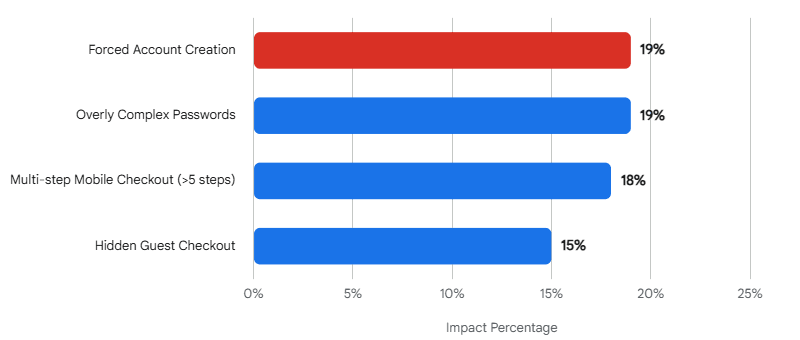
Top Usability Failures Impacting Conversions
How Poor Visual Hierarchy Kills Conversion Rate Optimization
Visual hierarchy directs the eye. Poor visual hierarchy results in a chaotic interface where every element competes equally. Call-to-action buttons blend into backgrounds, and promotional banners overshadow product details.
This lack of structure massively increases cognitive load. Utilizing Heatmap Analysis and tools like Hotjar helps verify that user attention flows toward primary conversion drivers. Shopify CRO systems rely on these behavioral analytics to optimize layouts.
What Weak Search Functionality Means for Conversational Commerce
Shoppers who utilize site search are high-intent buyers. Weak search functionality struggles with typos and natural language queries, leading to zero-results pages.
This immediately aborts the customer journey. Conversational commerce demands AI search visibility. AI optimized ecommerce storefronts understand semantic intent and salvage these high-intent sessions.
Where Inconsistent Branding Hurts Shopify Retention Systems
A visual identity must remain cohesive across every touchpoint. Inconsistent branding creates a disjointed user experience. This inconsistency subtly erodes Ecommerce authority building.
When the design language changes arbitrarily, the environment feels unstable. Shopify retention optimization requires uniform typography and high-fidelity assets tracked properly through GA4 and the Meta Pixel.
Why Poor Product Imagery Lowers Average Order Value
Buyers cannot touch products online. Poor product imagery communicates poor product quality. Modern brands must provide high-definition images and lifestyle context shots.
Technically optimizing these assets is vital for Ecommerce revenue optimization. Utilizing next-generation formats and Image Lazy Loading preserves page speed and protects the user experience.
Ready to eliminate design friction from your Shopify store?
Talk to Our Shopify ExpertsHow Overloaded App Ecosystems Ruin Shopify Performance Optimization
The Shopify App Store offers thousands of solutions. An overloaded app ecosystem severely degrades website performance. Bloated Shopify apps inject third-party scripts that conflict and crash browsers.
A sophisticated strategy utilizes Shopify Functions and custom backend integrations. Script Deferral and auditing the technology stack eliminate redundant plugins. Shopify speed optimization experts maintain a pristine codebase.
Why Most Shopify Stores Struggle To Rank on Google
Traffic acquisition relies heavily on visibility. Why Most Shopify Stores Struggle To Rank on Google is rarely due to a lack of blog content. It is almost always tied to weak SEO architecture. Standard setups often generate duplicate content issues and poor internal linking patterns.
Without expert Organic search engine optimization services, product pages become invisible. Implementing Semantic SEO systems involves structuring Semantic HTML cleanly. When search engines understand the context, organic rankings soar. Utilizing elite shopify seo services and professional web design and development services guarantees this architecture is built correctly.
How Lack of Personalization Hurts Ecommerce Growth Strategy
Treating every visitor identically is a massive missed opportunity. A lack of personalization ignores the distinct needs of returning visitors.
Ecommerce customer journey mapping reveals that personalized cross-sells increase lifetime value. Ecommerce behavioral design curates individualized experiences in markets like Houston and Denver.
What No AI-Search Readiness Means for Future-Ready Ecommerce Experiences
Search engines are transitioning into answer engines. If a store lacks AI-search readiness, it will be excluded from recommendations.
Brands must ensure AI Crawlability by maintaining high factual density. Semantic ecommerce architecture and AI Overview optimization are immediate realities. Generative Engine Optimization (GEO) dominates modern search discovery.
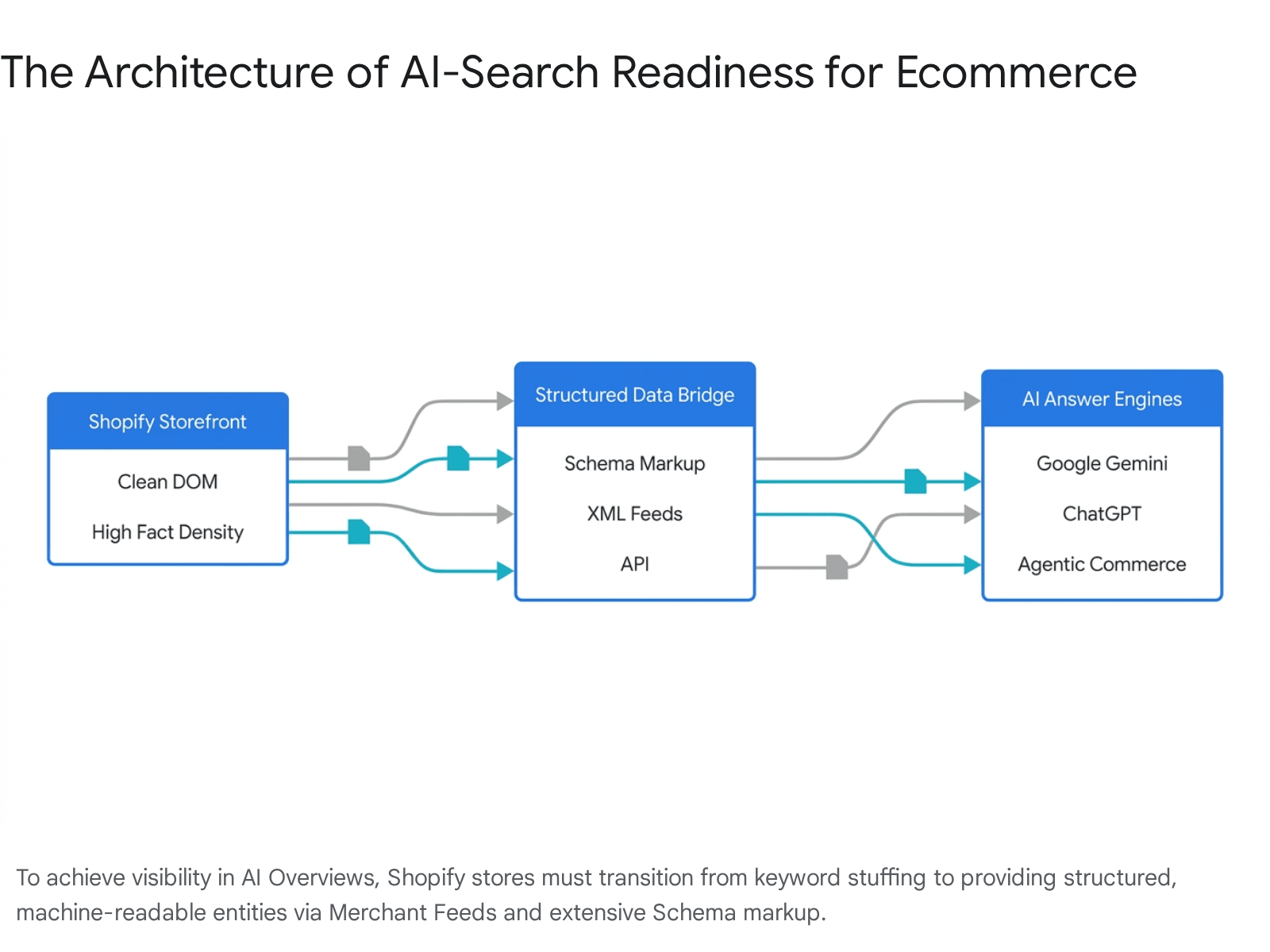
To achieve visibility in AI Overviews, Shopify stores must transition from keyword stuffing to providing structured, machine-readable entities via Merchant Feeds and extensive Schema markup.
Future-proof your store for AI-driven search discovery
Partner with 10 NativeFrequently Asked Questions
What design mistakes hurt Shopify sales the most?
Why is my Shopify store getting traffic but not converting?
Should I hire a shopify expert web design agency or use a template?
How does mobile UX impact Shopify conversion rate optimization?
Why do speed and Core Web Vitals matter for ecommerce?
What do customers expect from Shopify stores in 2026?
How do AI Overview optimized ecommerce pages affect sales?
Why are SEO and UX connected in Semantic ecommerce architecture?
Conclusion
The uncomfortable truth of digital retail is that acquiring traffic is merely the prologue. The actual battle for revenue is fought and won within the pixels of the store interface. Addressing these hidden design mistakes is a fundamental growth necessity. When a store suffers from sluggish load times, checkout anxiety, or weak mobile experiences, it systematically destroys the value of marketing investments.
Brands must understand Why Most Shopify Stores Fail at Converting Visitors into Buyers and address these leaks through rigorous optimization. Furthermore, understanding Why Most Shopify Stores Struggle To Rank on Google allows brands to shift toward modern semantic architectures. Partnering with a specialized shopify expert web design agency provides the strategic oversight needed to execute this level of technical sophistication.
By integrating elite web design and development services with highly targeted shopify seo services and comprehensive Organic search engine optimization services, 10 Native engineers future-ready ecommerce experiences. The brands that thrive will view conversion-focused design not as an expense, but as the most critical infrastructure supporting their digital empire. It is time to stop leaking traffic and start architecting a storefront designed to dominate the market.
Start Your Shopify Transformation