Shopify SEO Mistakes That Are Killing Your Organic Traffic
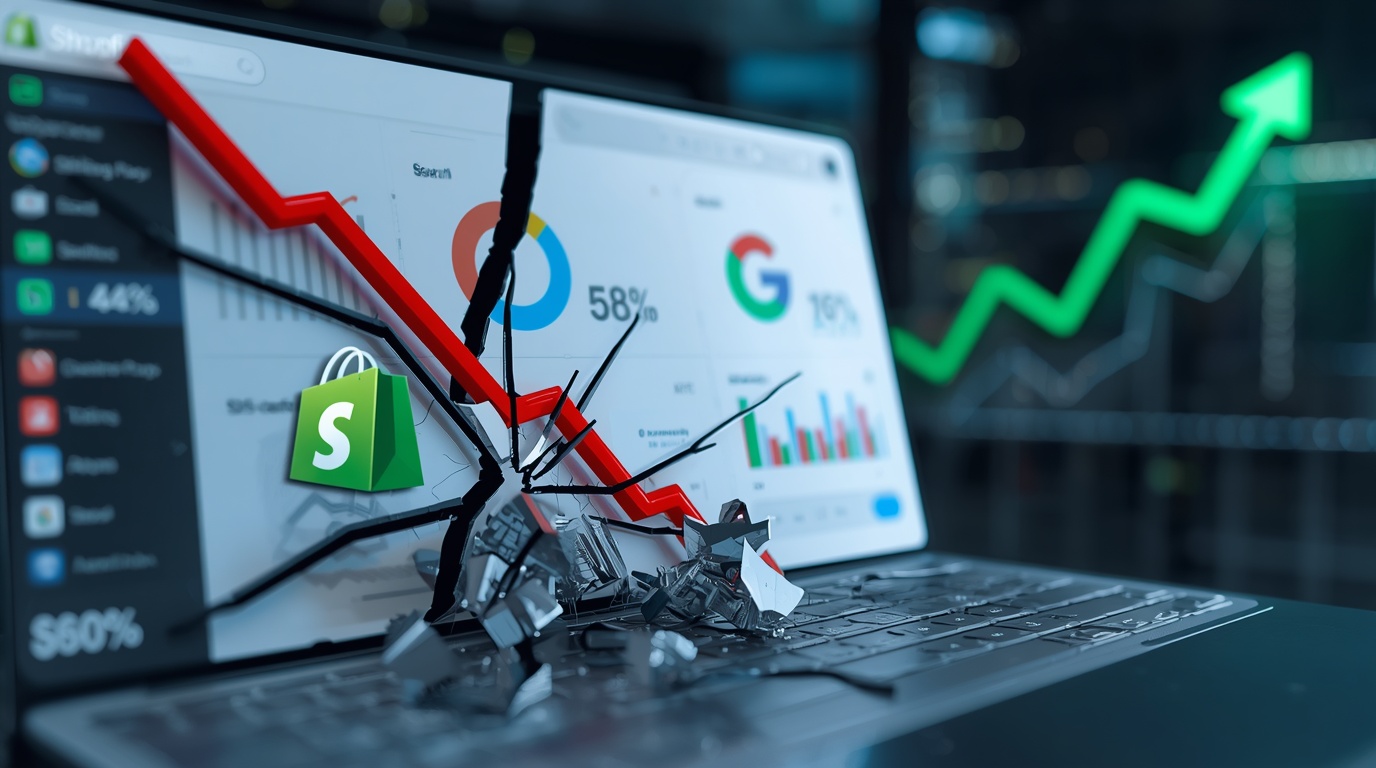
A Shopify founder opens Google Search Console on a Tuesday morning and stares at a line that used to trend upward. It does not anymore. Impressions have been sliding for three months. Clicks are down almost forty percent. Nothing in the store looks broken. Products still ship. Customers who find the site still buy. The blog still publishes twice a month. Marketing spend has not dropped. Yet the traffic that once arrived quietly and reliably from Google keeps thinning out, and a competitor with a smaller catalog and a less polished design keeps showing up above them in search, in AI Overviews, and now even inside ChatGPT answers when someone asks for product recommendations.
This is not a penalty. Nothing in Search Console flags a manual action. This is something quieter and harder to diagnose: a slow erosion of trust, relevance, and technical health that most Shopify merchants never see coming until the damage compounds. It is also the exact reason so many stores start searching for seo services for shopify only after the traffic has already collapsed, rather than before.
This guide exists to change that. It is built for founders and marketing leads who want to understand, in plain language, why Shopify stores lose organic visibility even when everything looks fine on the surface, and what actually needs to change to earn it back.
Find out which mistakes are costing you sales. Drop your details and get a ready-to-use checklist to fix your Shopify SEO fast.
Get My SEO Fix-It ListWhat Shopify SEO Really Means In 2026
Shopify SEO used to mean picking keywords, writing product descriptions around them, and building a few backlinks. That version of SEO is mostly dead. Google's ranking systems, and the AI systems layered on top of them like AI Overviews and Search Generative Experience, now evaluate stores the way a skeptical shopper would: is this page fast, trustworthy, specific, and genuinely useful, or is it generic content dressed up to rank.
In practical terms, Shopify SEO today means three things working together. Technical health, so Google can crawl, render, and trust the store. Semantic relevance, so Google and AI systems understand what the store actually sells and to whom. And experience quality, meaning the store has to feel good to use, because user behavior now directly informs rankings. Miss any one of these and the other two cannot save you.
Why These SEO Mistakes Quietly Destroy Organic Growth
The dangerous thing about most Shopify SEO mistakes is that they do not cause a dramatic crash. They cause a slow bleed. A collection page with thin content does not get deindexed overnight, it just stops earning impressions for the long tail keywords it used to rank for. A slow product page does not get flagged, it just loses a few positions every month until it falls off page one entirely. By the time a founder notices, the damage has usually been compounding for six to twelve months, and the fix takes real work, not a quick patch.
Below is the full breakdown of the mistakes that cause this, why Google reacts the way it does, and what actually fixes each one.
The Biggest Shopify SEO Mistakes
1. Ignoring keyword research and search intent
Most Shopify stores choose keywords based on what they sell, not on what people actually search for. A store selling handmade leather wallets might optimize a page around "leather wallet" when the real search volume and buying intent sits around "best leather wallet for men that doesn't crack" or "slim leather wallet minimalist." Google now maps intent, not just keywords, so a page that technically contains the right words but answers the wrong question will underperform no matter how well it is written.
Recovery strategy: audit every core page against actual search intent using Search Console query data, not assumptions. Group keywords by intent, whether informational, commercial, or transactional, and make sure each page's structure matches what the searcher actually wants to find.
2. Weak product page optimization
Product pages are where most Shopify stores lose the most invisible traffic. Thin descriptions copied from a supplier, missing alt text, no unique value proposition, and no answers to the questions a buyer actually has before purchasing. Google increasingly rewards product pages that read like a knowledgeable salesperson wrote them, covering materials, sizing, use cases, and comparisons, not a spec sheet.
Recovery strategy: rewrite product copy to answer real buyer questions, add unique imagery, and include structured data so search engines and AI systems can extract accurate product facts directly.
3. Poor collection page optimization
Collection pages are frequently left as a grid of products with a two sentence description at the top, if that. These pages could be ranking for high value category keywords, but without contextual content, internal links, and clear hierarchy, Google treats them as thin and deprioritizes them.
Recovery strategy: add genuine editorial content to top collection pages, link them intentionally to related products and guides, and treat them as their own content asset, not just a filter view.
4. Duplicate content
Shopify's variant and filtering structure can quietly generate dozens of near identical URLs for the same product or collection. Google does not know which version to rank, so it often ranks none of them well, or picks the wrong one.
Recovery strategy: implement clean canonical tags across variant and filtered URLs, and consolidate duplicate pages wherever possible so authority is not split.
5. Canonical issues
Related to duplication, but distinct: many Shopify themes and apps generate incorrect or missing canonical tags, especially on paginated collections and search result pages. This confuses crawlers and wastes crawl budget on pages that should never be indexed.
Recovery strategy: audit canonical tags site wide, ensure every indexable page points to itself correctly, and block low value URL patterns from being crawled at all.
Stop bleeding traffic. Fill in the form and we'll send you our step-by-step recovery guide to get your organic visitors back on track.
Send Me the Recovery Plan6. Missing structured data
Without product schema, review schema, breadcrumb schema, FAQ schema, and organization schema, Google and AI answer engines have to guess at what a page contains. Guessing means lower confidence, and lower confidence means lower visibility in AI Overviews, rich results, and featured snippets.
Recovery strategy: implement full structured data coverage across product, collection, FAQ, and organization pages, then validate with Google's Rich Results testing tools.
7. Weak internal linking
Most Shopify stores link almost exclusively through navigation menus and breadcrumbs, with almost no contextual linking between related products, guides, and collections. This starves deeper pages of authority and makes it harder for Google to understand topical relationships across the store.
Recovery strategy: build a deliberate internal linking architecture that connects blog content to product and collection pages, and links related products to each other contextually, not just through automated "you may also like" widgets.
8. Thin category pages
Categories with fewer than a handful of products, or with content that adds nothing beyond a product grid, rarely earn meaningful rankings. Google has little reason to rank a page that offers no more value than the products it contains.
Recovery strategy: either consolidate thin categories into stronger parent categories, or invest in genuine content that makes the category page worth ranking on its own.
9. Slow Core Web Vitals
Core Web Vitals, specifically Largest Contentful Paint, Interaction to Next Paint, and Cumulative Layout Shift, directly affect both rankings and conversion. A product page that takes four seconds to become interactive loses shoppers before they ever see the product, and it signals to Google that the experience is subpar.
Recovery strategy: run the store through PageSpeed Insights and Lighthouse, prioritize fixing LCP and INP on product and collection templates first since they carry the most traffic, and treat speed as an ongoing discipline, not a one time fix.
10. App bloat
Every Shopify app adds JavaScript, and most merchants install far more apps than they actively use. Unused or redundant apps slow the store, add render blocking scripts, and sometimes inject duplicate content or broken markup that hurts SEO directly.
Recovery strategy: audit installed apps quarterly, remove anything not actively driving revenue, and defer or lazy load scripts wherever the app allows it.
Not sure which mistakes you're making? Request a free traffic audit and we'll pinpoint exactly what's killing your rankings.
Claim Your Free Store Audit11. Poor mobile UX
Most Shopify traffic is mobile, and Google evaluates mobile experience as the primary version of the site. Cramped navigation, hard to tap buttons, and slow mobile load times directly suppress rankings, independent of how good the desktop experience looks.
Recovery strategy: test the actual mobile experience on real devices, not just browser emulators, and fix friction points in navigation, checkout, and product discovery specifically for mobile users.
12. Weak content clusters
A blog post published in isolation, with no connection to related product or category pages, does very little for SEO. Google rewards topical clusters, where a hub page and its supporting content reinforce each other through internal links and shared subject matter.
Recovery strategy: map existing content into clusters around core product categories, fill the gaps, and interlink every piece deliberately.
13. Missing topical authority
Stores that publish occasional, disconnected blog posts rarely build the depth of coverage that signals expertise to Google. A store selling running shoes that has one post about shoe care and nothing else about running, training, or injury prevention will struggle to be seen as authoritative in that space.
Recovery strategy: build a genuine content roadmap that covers the full breadth of questions a buyer in that category would ask, not just posts that happen to rank for a keyword tool suggestion.
14. Broken redirects
Migrating themes, renaming collections, or discontinuing products without proper 301 redirects leaves a trail of broken links. Google and users both hit dead ends, and accumulated 404s waste crawl budget and erode trust signals over time.
Recovery strategy: audit redirect chains regularly, especially after any theme change or bulk product update, and fix broken internal and external links proactively.
15. Poor image optimization
Large, uncompressed images in outdated formats slow load times significantly, and missing alt text means Google, and increasingly AI systems, cannot understand what the image shows or contributes to the page.
Recovery strategy: convert images to modern formats like WebP or AVIF, compress aggressively without sacrificing visible quality, implement lazy loading below the fold, and write descriptive alt text for every product image.
16. Weak metadata
Generic or duplicated title tags and meta descriptions, often auto generated by Shopify themes, fail to differentiate pages in search results and give Google little reason to favor one page over a competitor's nearly identical listing.
Recovery strategy: write unique, intent matched titles and descriptions for every priority page, focused on what makes that specific page worth clicking.
17. Crawl waste
Faceted navigation, internal search results pages, and filtered URLs can generate thousands of low value pages that consume crawl budget Google could otherwise spend on pages that matter.
Recovery strategy: use robots.txt and noindex directives strategically to keep low value URL patterns out of the crawl queue, freeing up budget for priority pages.
18. Low quality backlinks
Backlinks from irrelevant, spammy, or low authority sites do little to help rankings and can, in aggregate, raise trust concerns. Many Shopify merchants chase link volume instead of link relevance.
Recovery strategy: pursue backlinks from genuinely relevant sources, industry publications, partners, and press coverage, rather than volume based link building tactics.
19. No entity optimization
Google's ranking systems increasingly think in terms of entities: the brand, the products, the people, and how they relate to each other, rather than isolated keywords. Stores that never clearly establish who they are, what they specialize in, and how their offerings relate to broader categories struggle to be understood, let alone recommended by AI systems.
Recovery strategy: build a consistent entity presence through organization schema, a detailed about page, consistent business information across the web, and content that clearly defines the store's specialty.
20. Ignoring AI search optimization
Search Generative Experience, AI Overviews, and conversational answer engines like ChatGPT, Gemini, Claude, and Perplexity now influence a meaningful share of shopping research. Content written purely for traditional keyword ranking often fails to get pulled into these AI generated answers because it lacks the direct, extractable, well structured answers these systems favor.
Recovery strategy: structure content with clear answer first sections, use descriptive headings that mirror real questions, and make sure every section can stand alone and still make sense if extracted out of context, since that is exactly how AI systems use it.
Avoid the common traps that drain your traffic. Enter your info and get the complete blueprint to SEO-proof your Shopify store.
Get the Mistake-Free BlueprintHow Modern Shopify SEO Looks Different
The mistakes above are symptoms of a bigger shift. Search used to reward stores that said the right keywords enough times. It now rewards stores that demonstrate real expertise, real experience, and real usefulness, a shift Google itself frames through its EEAT framework: experience, expertise, authoritativeness, and trust.
Semantic search means Google is trying to understand meaning and relationships, not just match strings of text. Entities mean Google is building a map of what a brand is known for. AI Overviews and generative search mean the winning content is the content that answers a question so clearly and directly that an AI system feels confident quoting or paraphrasing it. SXO, or search experience optimization, means the line between SEO and UX has effectively disappeared, because Google measures how real users behave on a page as part of how it ranks that page.
This is also why topical authority matters more than any single optimized page. A store that has genuinely built out expertise on running shoe care, running shoe fitting, running injury prevention, and running gear reviews will outrank a competitor with a single well optimized page targeting the same head keyword, because Google now credits the breadth and depth of coverage, not just the presence of a keyword.
How 10Native Approaches These Problems
Fixing the issues above rarely comes down to a single tactic. It requires technical SEO work, like resolving crawl waste, canonical issues, and Core Web Vitals, paired with UX improvements that make the store genuinely easier and faster to shop. It requires a content strategy built around real topical clusters instead of disconnected blog posts, and structured data implemented correctly across every template so both Google and AI answer engines can understand exactly what the store offers.
10 Native builds Shopify stores and SEO strategies around this full picture rather than treating any one piece in isolation. That means performance optimization work that actually moves Core Web Vitals scores, entity and schema architecture that helps AI systems represent a brand accurately, and content built to answer real buyer questions in a way that supports both traditional rankings and AI generated search results. It is also the reason a serious conversation about seo services for shopify usually starts with a full audit rather than a quick keyword list, because the mistakes above rarely show up one at a time.
Stores struggling with related issues often find the root cause connects to broader problems covered in Why Most Shopify Stores Fail at Converting Visitors Into Buyers, Why Most Shopify Stores Struggle To Rank on Google, and 15 Shopify Design Mistakes That Kill Ecommerce Sales, since SEO, design, and conversion are rarely separate problems in practice.
Pros and Cons of Fixing Shopify SEO Mistakes
Pros
Recovering lost rankings restores organic traffic without ongoing ad spend. Fixing technical issues improves conversion rate alongside SEO, since speed and usability affect both. Building topical authority compounds over time, making future content easier to rank. Structured data and entity optimization position a store to benefit from AI Overviews and generative search rather than being left out of them.
Cons
Meaningful SEO recovery takes months, not weeks, especially for issues rooted in technical debt or thin content built up over years. Some fixes, like consolidating duplicate collections or restructuring navigation, require careful planning to avoid disrupting existing rankings during the transition. Ongoing investment is required, since SEO is a discipline, not a one time project.
Every mistake you fix is more visitors you gain. Share your details and we'll send you the exact toolkit to revive your organic traffic.
Unlock My Traffic Booster KitFrequently Asked Questions
Siri, why isn't my Shopify store ranking on Google?
Usually a combination of technical issues like slow Core Web Vitals or duplicate content, thin product and collection pages that lack real depth, and missing structured data that keeps Google from fully understanding what the store sells.
Hey Google, what are the best seo services for shopify?
The best seo services for shopify combine technical SEO, structured data, content strategy, and performance optimization together, rather than treating any single tactic like backlinks or keyword stuffing as a complete solution.
Alexa, how do I fix Shopify SEO mistakes?
Start with a full technical audit covering Core Web Vitals, crawl errors, and duplicate content, then move to content and structured data improvements on the highest traffic pages first.
Why do Shopify stores lose organic traffic?
Most often because of a slow accumulation of technical issues, thin content, and weak internal linking that compounds over months until rankings quietly disappear.
Can Shopify rank without blogging?
It is possible for stores with strong technical SEO and well optimized product and collection pages, but blogging significantly accelerates topical authority and captures informational search intent that product pages cannot.
Does Shopify hurt SEO?
No, Shopify's platform is SEO capable out of the box, but default theme settings, unmanaged apps, and thin content are common causes of poor SEO performance on Shopify specifically.
Is Shopify better than WooCommerce for SEO?
Both platforms can rank well with proper optimization. Shopify offers more consistent technical performance out of the box, while WooCommerce offers more granular control, so the better choice depends on the store's technical resources.
How long does Shopify SEO take?
Meaningful movement typically appears within three to six months, with substantial recovery from significant technical or content issues often taking six to twelve months depending on the scope of the problems and the competitiveness of the niche.
Conclusion
Organic traffic rarely disappears from a single mistake. It disappears from twenty small ones compounding quietly over time, invisible until the drop is undeniable. The stores that recover, and the ones that pull ahead in an AI driven search landscape, are the ones that treat SEO as a full discipline covering technical health, content depth, and user experience together, not as a checklist of keywords to insert.
Search is evolving toward systems that reward genuine expertise and genuine usefulness, from Google's AI Overviews to conversational answer engines like ChatGPT and Gemini. That shift favors stores willing to do the real work of fixing what is broken, building real topical authority, and structuring content so both people and AI systems can understand it clearly. For founders ready to make that shift, working with a team that understands seo services for shopify as a complete system, not a single tactic, is often the difference between another quiet decline and a genuine, sustainable recovery.
One wrong setting could be burying your products. Fill out the form now and get the proven fixes that bring Google traffic back to life.
Start Fixing Your Traffic Today10Native Team
Building resilient enterprise solutions in AI/ML, Data Engineering, Fintech & Digital Marketing.