Custom Website vs Template Website: Which Is Better for Business?
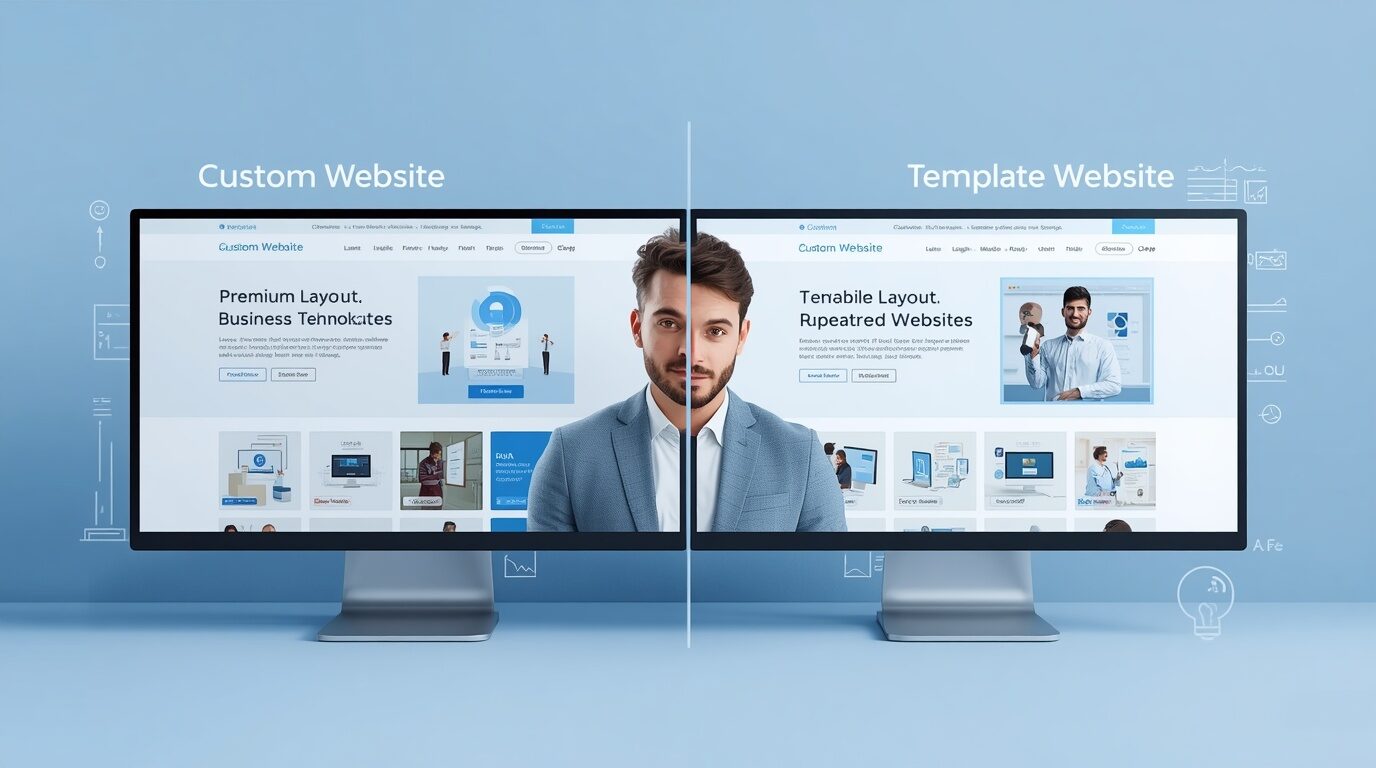
Every business owner eventually asks the same question at some point in their growth. Should the website be built from scratch, or is a template good enough to get started? It sounds like a simple decision on the surface, almost like choosing paint colors for an office wall. But this single choice quietly shapes how customers perceive the brand, how search engines rank the business, how AI systems like Google AI Overview and ChatGPT understand and recommend the company, and how much room the business actually has to grow over the next five years. Choosing between Custom web design and development Services and a pre-built theme is rarely just a design decision. It is a business infrastructure decision.
Most owners do not realize this until they are already locked into a system that cannot keep up with them. A template feels affordable and fast in the beginning. Custom web design and development Services feel slower and more expensive at first glance. But the businesses that scale successfully almost always look back and realize the website was either the foundation that carried them forward or the ceiling that quietly held them back. This article breaks down that decision in full detail, covering everything from conversions and SEO to AI search visibility, security, scalability, and long term ROI, so you can make the choice with complete clarity rather than guesswork.
Not sure which route is right for you? Download our free custom vs template comparison guide and make the smart choice for your business.
Get Your Free Comparison GuideWhy Website Architecture Decides Business Growth Before Marketing Does
Before a single ad campaign runs or a single blog post gets published, the website has already made a decision about the business. It has decided how fast pages load, how easily search engines can understand the content, how smoothly a visitor moves from curiosity to inquiry, and how much flexibility the team has to adapt as the business changes. Marketing amplifies whatever the website already is. If the foundation is rigid, generic, or slow, marketing spend simply pushes more people into a weak experience faster.
This is why so many businesses chase new ad strategies, new copywriters, or new offers when traffic is not converting, without ever looking at the one variable sitting underneath everything else. A strong website architecture, built through proper custom website development company practices, does not just look better. It behaves better across every metric that actually matters for growth.
What Is the Real Difference Between a Custom Website and a Template Website
A template website is built from a pre-made theme, often sold to thousands of other businesses, then adjusted with colors, logos, and some layout tweaks. A custom website is built specifically around one business, its customers, its sales process, and its long term goals, using bespoke website development principles from the ground up.
The difference feels small on the surface but becomes massive underneath. Here is a direct comparison that most businesses never see laid out clearly.
| Factor | Template Website | Custom Website |
|---|---|---|
| Design uniqueness | Shared with thousands of other sites | Built specifically for one brand |
| Performance | Often bloated with unused code | Optimized from the ground up |
| SEO flexibility | Limited by theme structure | Fully controlled and semantic |
| Scalability | Breaks down as needs grow | Built to expand with the business |
| Security | Depends on third party plugins | Controlled and hardened intentionally |
| Customization | Restricted to theme options | Unlimited, based on business needs |
| Long term cost | Rising maintenance and plugin fees | Higher upfront, lower long term cost |
| AI and search readiness | Generic, hard to differentiate | Semantic, structured, AI friendly |
This table alone explains why so many established companies eventually migrate away from templates, even after years of relying on them.
How Template Websites Quietly Limit Long Term Growth
Templates rarely fail on day one. They fail slowly, in ways that are difficult to notice until the business tries to do something the theme was never built to handle.
The first issue is technical debt. Every template comes preloaded with code the business does not need, features it will never use, and a structure built for a generic audience rather than a specific one. Over time, developers have to work around this instead of with it, and every small update takes longer than it should.
The second issue is plugin dependency. Templates rely heavily on plugins to add functionality, and each plugin becomes another point of failure. One plugin update can break another plugin, slow the site down, or introduce a security gap. Businesses often do not realize how much of their website is held together by third party code they do not control.
The third issue is vendor lock-in. Many themes and page builders make it difficult to migrate content elsewhere without starting over. What felt like a fast and affordable solution in year one can turn into a costly rebuild in year three, simply because the platform never intended for the business to outgrow it.
Stop guessing and start deciding. Enter your details and get a simple checklist that helps you pick the perfect website type for your goals.
Send Me the Decision ChecklistWhy Performance and Core Web Vitals Influence Both Rankings and Revenue
Website speed is not just a technical detail anymore. Google measures a set of metrics called Core Web Vitals, and they directly influence both search rankings and how visitors behave on a page.
Largest Contentful Paint, or LCP, measures how quickly the main content of a page becomes visible. Cumulative Layout Shift, or CLS, measures how much elements move around while a page loads, which frustrates users when a button shifts right as they try to click it. Interaction to Next Paint, or INP, measures how quickly a page responds after someone clicks or taps something. Tools like Lighthouse and GTmetrix measure these scores in detail, and templates almost always struggle here because of unused code, oversized images, and unnecessary JavaScript running in the background.
Custom web design and development Services address this at the architecture level. Instead of adding speed fixes after the fact, performance is built in from the start through lazy loading, image optimization, script deferral, CDN delivery, and clean semantic HTML. The result is a site that not only ranks better but keeps visitors engaged instead of losing them in the first three seconds.
How Security and Accessibility Separate Custom Builds From Templates
Templates depend on a wide ecosystem of third party plugins for almost everything, from forms to security to SEO tools. Each of these adds a potential vulnerability, and because thousands of other websites use the exact same theme, attackers already know exactly where to look for weaknesses.
Custom builds reduce this risk significantly because the codebase is smaller, more intentional, and not shared publicly across the internet in the same predictable structure. Security can be built around the specific business rather than patched together from generic plugins.
Accessibility follows a similar pattern. WCAG guidelines exist to make sure websites work for people using screen readers, keyboard navigation, or assistive technology. Templates often treat accessibility as an afterthought, while a properly built custom site incorporates semantic HTML, proper contrast, alt text structures, and navigable layouts from the beginning, which also happens to improve SEO and AI readability at the same time.
Why AI Search Visibility Depends on Website Architecture
Search behavior has changed. People are no longer only typing keywords into Google. They are asking Google AI Overview, ChatGPT, Gemini, Claude, and Perplexity full questions and expecting direct answers. This shift, often described through GEO, AEO, and SXO, rewards websites that are structured clearly enough for AI systems to understand, extract, and cite.
This is where templates fall behind in a way most business owners never notice. Generic theme structures produce repetitive, shallow HTML patterns that AI systems have already seen millions of times across other websites using the same theme. Custom web design and development Services allow structured data, schema markup, and semantic HTML to be built specifically around how the business wants to be understood, which directly improves the odds of being cited inside an AI generated answer instead of buried under competitors using the same template.
What Makes Custom Websites More Trustworthy to Visitors
Trust is formed within seconds, often before a visitor reads a single word. This is called cognitive fluency, and it explains why people trust clean, intentional design more than something that feels familiar in a generic way. Many internet users, even without technical knowledge, can sense when a website was built from a common theme. It creates a subtle feeling of interchangeability, as if the business could be any business.
Authority bias plays a role here as well. Visitors associate originality with expertise. A website that feels considered, specific, and well organized signals that the business behind it takes its work seriously. Decision fatigue also matters. Visitors instinctively favor clear navigation and intuitive layouts, and abandon anything that requires extra effort to understand. Custom websites are built to guide a visitor's attention deliberately, rather than relying on a generic layout that was designed for no one business in particular.
Still confused? Request a free 15-minute consultation and we'll help you determine which option gives you the best ROI.
Claim Your Free ConsultationHow Scalability and Integration Needs Expose Template Limitations
As a business grows, its website needs to grow with it. This might mean connecting a CRM to track leads, integrating an ERP system for inventory and operations, or preparing for AI personalization that adjusts content based on visitor behavior. Templates were not built with this kind of flexibility in mind, and businesses often discover this only when they try to add functionality the theme cannot support.
Custom builds are typically designed with API-first development in mind, meaning the website can talk to other systems cleanly instead of relying on fragile workarounds. This becomes especially important for businesses that plan to scale their operations, not just their traffic. Enterprise web development, in particular, depends heavily on this kind of readiness, since larger companies rarely operate with just one system.
Why B2B and Enterprise Businesses Need More Than a Template
A B2b Web design and development company faces a different challenge than a typical consumer brand. B2B buyers research longer, compare more carefully, and expect a level of professionalism that signals operational maturity. A templated website, no matter how nicely it is styled, tends to undercut that impression the moment a buyer notices it looks similar to five other vendors they have already reviewed.
This is closely tied to a pattern explored in our related resource, Why Most B2B Websites Fail To Generate Qualified Leads, where weak information architecture and generic messaging are consistently identified as the reason inquiries stay low even when traffic looks healthy. A Corporate web design and development Agency approach solves this by building a site around the actual buying journey of enterprise clients, rather than a generic template flow meant for broad consumer traffic.
How E-Commerce Businesses Benefit From Custom Development
E-commerce is one of the clearest examples of where templates start to break down under real business pressure. Product catalogs grow, checkout flows need to be optimized constantly, and every additional plugin used to extend a theme adds friction to page speed and conversion rates.
A Shopify web development Company that understands custom architecture can build storefronts that go far beyond what a standard theme allows, from custom filtering systems to advanced checkout logic to deeper analytics integrations. Our related piece, How 2026 is Redefining E-Commerce Website Design And Development, goes deeper into how buyer expectations have shifted toward faster, more personalized shopping experiences that templates simply were not designed to deliver at scale.
See the numbers for yourself. Grab our free ROI calculator and compare the long-term value of custom vs template websites instantly.
Get the ROI CalculatorWhere Template Websites Still Make Sense
To be fair, templates are not always the wrong choice. A very early stage business testing an idea, a solo entrepreneur with a limited budget, or a short term campaign page can reasonably use a template to move quickly without a large investment.
When a template can work:
- Testing a new business idea before committing to a full build
- A temporary landing page for a short campaign
- A very small budget with no immediate scaling plans
- A simple portfolio with minimal functionality needs
When a template becomes a liability:
- The business depends on organic search or AI visibility for growth
- The site needs to integrate with a CRM, ERP, or other business systems
- Conversion rate and user trust directly affect revenue
- The business plans to scale within the next one to three years
- Brand differentiation is a core part of the business strategy
How to Decide Between a Custom Website and a Template for Your Business
A simple framework can help clarify the decision. Ask the following questions honestly.
- Does this website need to convert visitors into paying customers reliably?
- Will the business need to integrate other systems like a CRM or ERP within the next two years.
- Is search visibility, including AI search visibility, a meaningful part of the growth strategy.
- Does the brand need to feel distinct from competitors who may already be using similar themes.
- Is the business planning to scale operations, product lines, or content significantly.
If three or more of these apply, Custom web design and development Services will almost always outperform a template in both experience and return on investment over time. Businesses in competitive markets, whether in New York, Los Angeles, Chicago, Dallas, Houston, Austin, Seattle, Miami, San Francisco, Atlanta, Denver, or Nashville, tend to face this decision earlier than they expect, simply because local competition pushes differentiation to the front of the conversation faster.
Your business deserves the right foundation. Fill out the form and get expert insights to choose between custom or template—without the regret.
Unlock the Right Choice NowFrequently Asked Questions
Are custom websites better than templates for businesses that plan to grow?
Yes, in most cases. Custom websites are built with future scalability in mind, while templates are built for broad, generic use, which limits flexibility as the business grows.
Which option performs better for SEO?
Custom websites generally perform better for SEO because they allow full control over site structure, semantic HTML, and technical optimization, rather than working within the limits of a theme.
Which website type is better for AI search visibility?
Custom builds tend to perform better here because structured data and semantic architecture can be tailored specifically for AI retrieval, rather than relying on repetitive template patterns already seen across thousands of other sites.
Are template websites bad for long term SEO?
Not inherently bad, but limited. Templates can rank initially, but businesses often hit a ceiling once they try to implement deeper technical or semantic SEO strategies the theme was not designed to support.
Is a custom website worth the higher upfront investment?
For businesses focused on long term growth, yes. The higher upfront cost is usually offset by lower long term maintenance, stronger performance, and better conversion rates over time.
Which option is better suited for startups just getting started?
Templates can work temporarily for very early stage testing, but most startups planning to scale within a year or two benefit more from investing in a custom foundation early.
Should my business use a custom website or a template?
For most growing businesses, a custom website tends to perform better long term because it can adapt to changing needs, while a template is better suited for very short term or limited use
Are template websites bad for SEO?
Template websites are not automatically bad for SEO, but they often limit how deeply a business can optimize its structure, content, and technical performance compared to a custom built site.
Conclusion
The comparison between a custom website and a template website ultimately comes down to how much control a business wants over its own growth. Templates offer speed and a lower entry cost, but they trade away flexibility, performance, security, and long term scalability in the process. Custom web design and development Services take longer and cost more upfront, but they build a foundation that supports SEO, AI search visibility, conversions, and future business needs without the ceiling that templates eventually create.
At 10 Native, this distinction shapes how every project is approached, from Shopify storefronts to enterprise level rebuilds, because a website should be an asset that keeps working harder as the business grows, not a limitation the business has to work around. Choosing the right foundation now is almost always cheaper, faster, and more effective than rebuilding later once the limits of a template have already slowed the business down.
One wrong choice can cost you time and sales. Share your details and we'll send you the ultimate framework to decide what's best for your business.
Start Building Smarter Today10Native Team
Building resilient enterprise solutions in AI/ML, Data Engineering, Fintech & Digital Marketing.