How to Choose an Organic SEO Agency or Consultant (9 Questions to Ask)
You typed "organic SEO agency" into Google and got a wall of near-identical websites. Every one promises more traffic. None of them tells you how to tell the good ones from the rest.
Here is the short version. The right organic SEO agency or consultant can show real past work, explains every change in plain English, measures success by leads and sales, and never promises you a number one ranking. The rest of this guide gives you the questions, the red flags and a fair proposal checklist, so you can decide before you sign anything.
How do you choose an organic SEO agency or consultant?
Choose the one that is open about its work, honest about results, and interested in your business before it talks about its own services. Google's own guidance for site owners points the same way: ask for past work, ask how success will be measured, and walk away from anyone who guarantees a top spot.
Use this four-part test on every company you talk to:
- Proof. They show real work and let you speak to past clients.
- Process. They explain what they will do in the first few months and why.
- Honesty. They talk in ranges and likely outcomes, not guarantees.
- Fit. They ask about your customers, your competitors and your margins.
If a company fails any one of these, keep looking. There are plenty of providers, so you can afford to be picky.
Should you hire an agency or a solo SEO consultant?
Hire a solo consultant if your needs are narrow, such as an audit or advice for an in-house team. Hire an agency if you need ongoing work across content, technical fixes and links, because one person rarely covers all of that well.
Here is the practical difference:
- Consultant: one point of contact, often lower cost, great for strategy and audits. The risk is capacity. If they get sick or busy, your work stalls.
- Agency: a team of writers, developers and analysts. Better for ongoing delivery and for stores or sites that need development changes too. The risk is being handed to a junior person after the sales call.
Whichever you pick, ask who will actually do the work week to week. Then ask to meet that person.
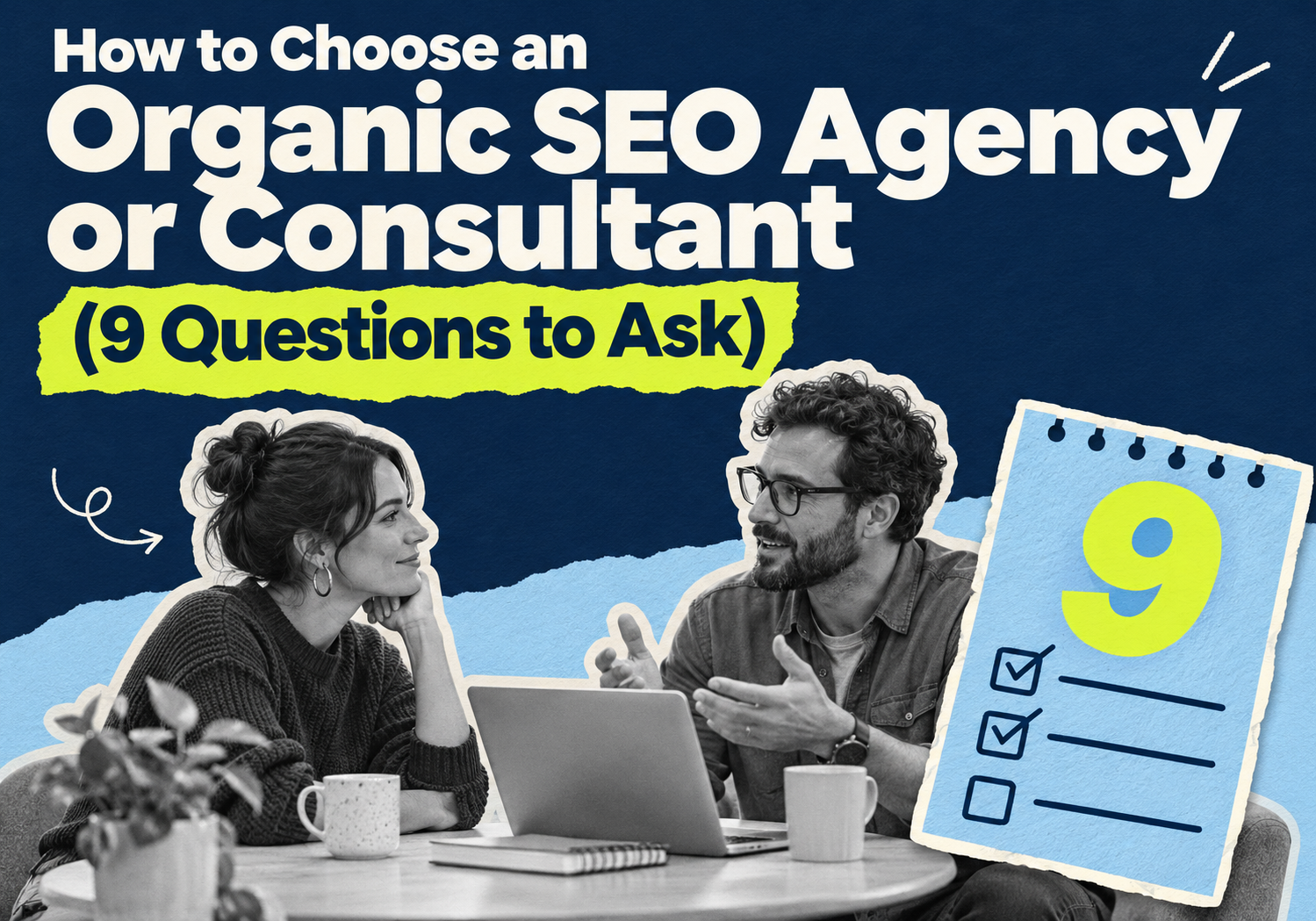
What 9 questions should you ask before you sign?
Ask these nine questions in your first call. The answers tell you more than any sales deck.
1. Can you show me past work and let me talk to a client? Google suggests asking for success stories and checking references. Ask those clients if the work was useful and the team was easy to work with.
2. What results do you expect, over what time, and how will we measure them? A good answer gives a range and names the numbers, such as organic leads, calls or orders. Rankings alone are not enough.
3. Will you explain every change you make and why? You should never be kept in the dark about edits to your own site.
4. Do you follow Google Search Essentials? Any provider should say yes without hesitation and be able to point to Google's documentation when they give advice.
5. What do you know about my industry and my location? Local service businesses and online stores need different plans. Experience in your market matters.
6. What will you do in the first 90 days? Look for specifics: a site audit, keyword and question research, fixes to your pages, new content and tracking set up.
7. Who owns the work? Your content, your accounts and your reports should belong to you if you leave.
8. How do you report? Ask for a sample report. It should connect SEO work to business results, not only list keywords.
9. What would make you tell me SEO is not right for me yet? An honest provider has an answer. If the answer is never, be careful.
What are the red flags of a bad organic SEO company?
The biggest red flag is a guarantee of a specific ranking. Google says plainly that nobody can guarantee a number one spot, and a Google search advocate said in a 2025 podcast discussion that promises about ranking or traffic are usually a warning sign.
Watch for these others too:
- Secret methods. Vague plans and refusals to explain changes. Google warns that you are responsible for what the company you hire does to your site, and deceptive tactics can get a site removed from search results.
- Claims of a special relationship with Google. Google says there is no priority submit or special access you can buy.
- Cold emails about your rankings. Google tells owners to treat unsolicited ranking offers with suspicion.
- Link schemes. You should never have to link to your SEO provider, and you should avoid anyone who sells link popularity schemes.
- Tool hype. Google does not endorse third-party SEO tools, so be cautious of any vendor who says Google approved theirs.
- Vague AI promises. Advice about showing up in AI answers should still trace back to something Google or another platform has published.
What should a fair SEO proposal include?
A fair proposal lists the work, the timeline, the reporting and the exit terms in writing. If you cannot tell from the document what you are paying for each month, ask for it to be rewritten.
Use this checklist:
- A written scope broken into tasks, not just a monthly fee
- A starting audit and the findings that come from it
- Clear goals tied to leads, calls or orders
- A reporting schedule and a sample report
- Who does the work and who you contact
- Notice period and what you keep if you stop
- Access terms: what they need to log in to and why
A useful audit also gives realistic estimates of the improvement you can expect and the work it will take, according to Google's guidance. If an audit only lists problems and offers no plan, it is a sales tool, not an audit.
How do you give access safely and check references?
Give the least access needed at each step. During an audit, Google advises read-only access to Search Console rather than write access. Give more only after you trust the provider and have agreed on the work.
To check references:
1. Ask for two or three past clients in a similar situation to yours.
2. Ask each one what changed, how long it took and how the communication felt.
3. Ask whether anything went wrong and how it was handled.
If a provider refuses to share any client names, ask why. Sometimes work is under contract, but they should still be able to offer a reference or a case summary.
What does a good first 90 days look like?
A good first 90 days is mostly foundations: an audit, fixes, a plan and the first pieces of content. Do not expect miracles in that window, and be wary of anyone who sells them. Google does not publish a timeframe for results, which is why you should ask your provider what to expect and how it will be measured.
Here is a sensible example of what to look for:
- Month one: audit your site, check tracking, review Search Console, research the questions your customers ask and agree on priorities.
- Month two: fix technical and page-level issues, improve key pages, and start publishing content that answers real questions.
- Month three: expand content, strengthen local or product pages, review early data and adjust the plan.
Organic SEO compounds over time. For a plain-English look at the full process, see our guide to organic SEO services in the USA.
How can 10Native help you choose, or do the work?
10Native can do the work, or review your current agency's proposal and tell you plainly what we think. We are a full-service digital agency based in Prosper, Texas, with an office in Warner Robins, Georgia, and a production team in Karachi, Pakistan.
Here is what we can help with:
- Organic SEO and content. SEO, AEO and GEO content plans built around the questions your customers ask. See our digital marketing services.
- Local SEO. If you serve customers in Austin, we have a page for that: SEO in Austin. We also work on local SEO for Savannah and other markets.
- Online stores. Shopify and WordPress builds and fixes, so the technical side of SEO does not stall.
- White-label work. If you run an agency, we can deliver SEO and development work under your brand.
We will not promise rankings. Nobody honest can. What we can promise is a written scope, plain-English explanations and reporting tied to business results. If SEO is not the right next step for you, we will say so.
Not sure whether your SEO provider is doing the right work? Send us their proposal and we will give you a straight read on it.
Talk to 10NativeReady to talk?
Call us at 415 489 9314 or 214 758 7971, or email info@10native.com. You can also use our contact page. Tell us your site, your market and what you have tried so far, and we will tell you what we would do first.
Frequently asked questions
Should I hire an organic SEO agency or a freelance consultant?
Can an SEO company guarantee a first page ranking?
How long does organic SEO take to show results?
What access should I give an SEO provider?
How do I know if my current SEO agency is doing a good job?
Is organic SEO worth it for a small business?
Do you work with businesses in Austin and other Texas cities?
10Native Team
Building resilient enterprise solutions in AI/ML, Data Engineering, Fintech & Digital Marketing.