AI Chatbot for Small Business: What Should It Handle?
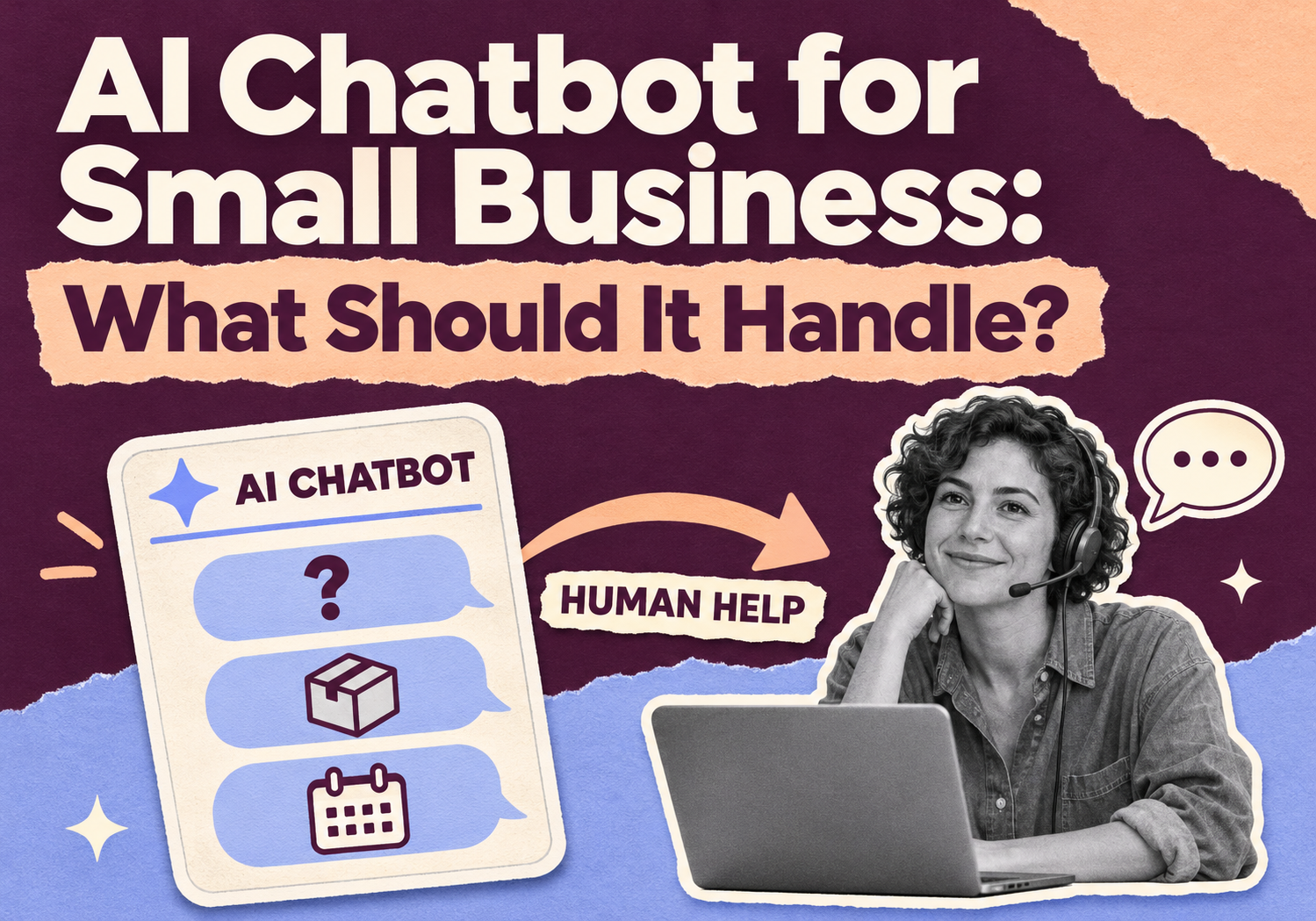
An AI chatbot for small business works best on routine questions with one correct answer: your hours, order status, shipping times and how to book. It should hand everything else to a person. With Black Friday on November 27, 2026 kicking off a busy stretch, it's tempting to let a bot answer everything. Before you do, decide what it may say, what it may do and when it has to step aside. Here's how to draw those lines.
What should an AI chatbot for small business handle?
Give your chatbot the questions where the answer is already written down and rarely changes. Keep judgment calls, money and upset customers with your team.
Good first jobs:
- Opening hours, holiday hours, location and parking
- Shipping times and your published return policy
- Order status, if the bot can securely look up the real record
- Basic product facts taken from your own product pages
- Collecting a name, contact details and the reason for the request
- Pointing people to your booking or quote form
Jobs to keep with a person:
- Refunds, credits, discounts and policy exceptions
- Complaints, billing disputes and anything with an angry tone
- Medical, legal, financial or safety questions
- Custom quotes and promises about delivery dates
- Anything the bot can't answer from your approved content
A simple test helps. Would you let a new hire answer this on day one with only your help page open? If not, your bot shouldn't answer it alone either.
Are you responsible for what your chatbot says?
Plan as if you are. In Moffatt v. Air Canada, decided on February 14, 2024, a British Columbia tribunal held the airline liable after its website chatbot gave a customer wrong information about bereavement fares.
The bot said he could apply for the reduced fare within 90 days of the ticket being issued. The airline's policy page said the discount didn't cover requests made after travel. The tribunal said Air Canada was responsible for everything on its website, chatbot included. Having the correct policy on another page didn't excuse the error. The damages were small, about 650 Canadian dollars plus interest and fees (American Bar Association summary).
It's one Canadian tribunal case, so don't read it as US law. The practical lesson still travels well: your bot and your policy pages need to say the same thing. When a holiday return window changes, update both on the same day.
Do you have to tell customers they're talking to a bot?
In some places, yes. Our advice is to tell everyone, wherever they are. A clear first message costs you nothing.
Three examples, checked on November 26, 2026:
- Maine: you can't use an AI chatbot in consumer trade in a way that may mislead a reasonable person into thinking it's human, unless you clearly say it isn't. A violation falls under the state's Unfair Trade Practices Act (10 M.R.S. 1500-DD).
- California: the bot law covers online communication with people in California. It targets bots that mislead people about being artificial in order to push a sale or sway a vote. A clear and noticeable disclosure protects the operator from liability under that section (Business and Professions Code 17941).
- European Union: since August 2, 2026, Article 50 of the AI Act has required that people be told they're dealing with an AI system, unless that's obvious. The duty sits with the system's provider (Goodwin).
This isn't a full list or legal advice. Rules differ by place and industry, so ask an attorney how they apply to you.
An opening line can be this plain: "Hi, I'm an automated assistant, not a person. I can help with orders, shipping and hours. Type agent any time to reach our team."
When should the chatbot hand off to a human?
Hand off as soon as the customer asks, and any time the bot isn't sure. Gartner surveyed 3,566 business and consumer customers in February and March 2026. 87% said companies using generative AI for service must offer a way to reach a human (Gartner release, August 4, 2026).
The same survey found that 50% said generative AI made their interactions easier. So customers aren't simply against it. They don't want to get stuck. Gartner also advises against making AI the required first step for every issue.
Set these handoff triggers:
1. The customer asks for a person.
2. The bot can't find an approved answer.
3. The topic involves money, a complaint, safety or personal data changes.
4. The customer repeats the question or sounds frustrated.
5. The bot has tried twice and the problem isn't solved. Two is our suggested starting point, so adjust it after reading real chats.
Pass the chat history along, so your customer doesn't have to start over. After hours, say when someone will reply and collect contact details. Don't pretend a person is waiting.
Can someone trick your chatbot?
Yes. It's called prompt injection: text that changes how an AI model behaves in ways you didn't intend. It can come from a chat message, or be hidden in a web page or file the bot reads. OWASP's guidance says it may not be fully preventable, so limit what a tricked bot can do.
- Give the bot the least access it needs. A shipping-question bot doesn't need your whole customer database.
- Require a person to approve high-risk actions, such as refunds or account changes.
- Check a customer's identity in your system before showing order or account details. Don't let the AI decide who someone is.
- Test it like a troublemaker. Ask it to ignore its rules, invent a discount or show another person's order.
If your bot will take actions, not only answer questions, read our AI agent safety rules for small businesses first.
How do you launch a chatbot without making a mess?
Start narrow, test with real questions and widen only after the answers hold up. If you can't test it properly yet, a clear help page and contact form are the safer choice for now.
1. Pull your last 50 to 100 customer questions. Check email, chat, texts and call notes. Group repeats. If you have fewer, use what you've got.
2. Pick five to ten question types with settled answers.
3. Write one approved source for each. Remove old prices, expired offers and conflicting policies.
4. Write the rules. List what the bot must never promise, and what it says when it doesn't know.
5. Build the handoff. Name who receives chats, where they arrive and how fast you'll reply.
6. Test before launch. Try typos, vague questions, angry messages and trick requests.
7. Review transcripts daily at first. Fix the source content, then test that question again.
Judge it by more than the number of chats it closes. A customer who gave up can look like a solved case. Track wrong answers, handoffs, repeat contacts for the same problem and leads or orders that followed. Also check how long chat records are kept and who can read them.
Still deciding whether chat is the right first project? Our guide to where small businesses should start with AI can help you compare options.
How can 10Native help with your AI chatbot?
10Native's AI and machine learning services can help you plan and build a chatbot around the limits above. We're a Texas LLC headquartered in Prosper, with a sub-office in Warner Robins, Georgia and a production center in Karachi, Pakistan.
Here's where we can help:
- Scoping: sort your customer questions into bot, human and not-yet groups.
- Build and connection: set up the assistant, its approved content and the handoff, using our AI, data engineering and enterprise technology services.
- Your website or store: add it through our Shopify, WordPress and web design work.
- Content cleanup: rewrite help pages and FAQs so people and the bot get the same answer.
- Agencies: deliver this work white-label for your clients.
What can be connected depends on the tools you already use. No chatbot answers correctly every time, and we won't promise sales, savings or error-free replies. We also don't replace legal advice.
Not sure what your chatbot should answer and what your team should keep? Send us your most common customer questions and we'll talk through a sensible first version.
Talk to 10NativeWhat's your next step?
Open your inbox and write down the ten questions you answer most. Mark each one bot, human or fix the policy first. That short list is your chatbot plan, and it's useful even if you never launch one.
Want help turning it into a working setup? Call 10Native at 415 489 9314 or 214 758 7971, email info@10native.com, or use our contact page.
10Native Team
Building resilient enterprise solutions in AI/ML, Data Engineering, Fintech & Digital Marketing.