AI for Small Business: 6 Practical Ways to Start in 2026
Most owners don't need a big AI plan. You need one slow, repetitive task that AI can take off your plate. That's the honest way into AI for small business, and it's what this guide walks through: where AI helps, where it doesn't, and how to start without burning a quarter's budget.
First, some context. The U.S. Chamber of Commerce's 2026 small business report, published October 2, 2026, says 66% of small businesses now use AI, up from 23% in 2023. Census Bureau survey data, summarized by the Minneapolis Fed in May 2026, paints a quieter picture: 17% of firms with fewer than 20 employees reported using AI in April 2026, compared with 30% of firms with 250 or more employees. The two surveys ask different questions, so they don't contradict each other. Our read: plenty of owners have tried an AI tool, but far fewer have built one into how the business actually runs.
What does AI actually do for a small business?
AI handles repetitive, pattern-based work, like drafting, sorting, summarizing and predicting, so your people can spend their time on decisions and customers. It comes in two main flavors, and knowing the difference saves money.
- Ready-made generative AI tools. These are the chat-style assistants that draft emails, summarize documents and answer questions. You can start this week.
- Machine learning on your own data. These are models trained on your sales, inventory or customer history to forecast demand, score leads or recommend products. They need clean data and a bit of engineering.
Most small businesses should start with the first and move to the second only when the data is ready. If your records live in five spreadsheets and two inboxes, the real first project is tidying that up. That's what our data engineering team does.
Where should a small business start with AI?
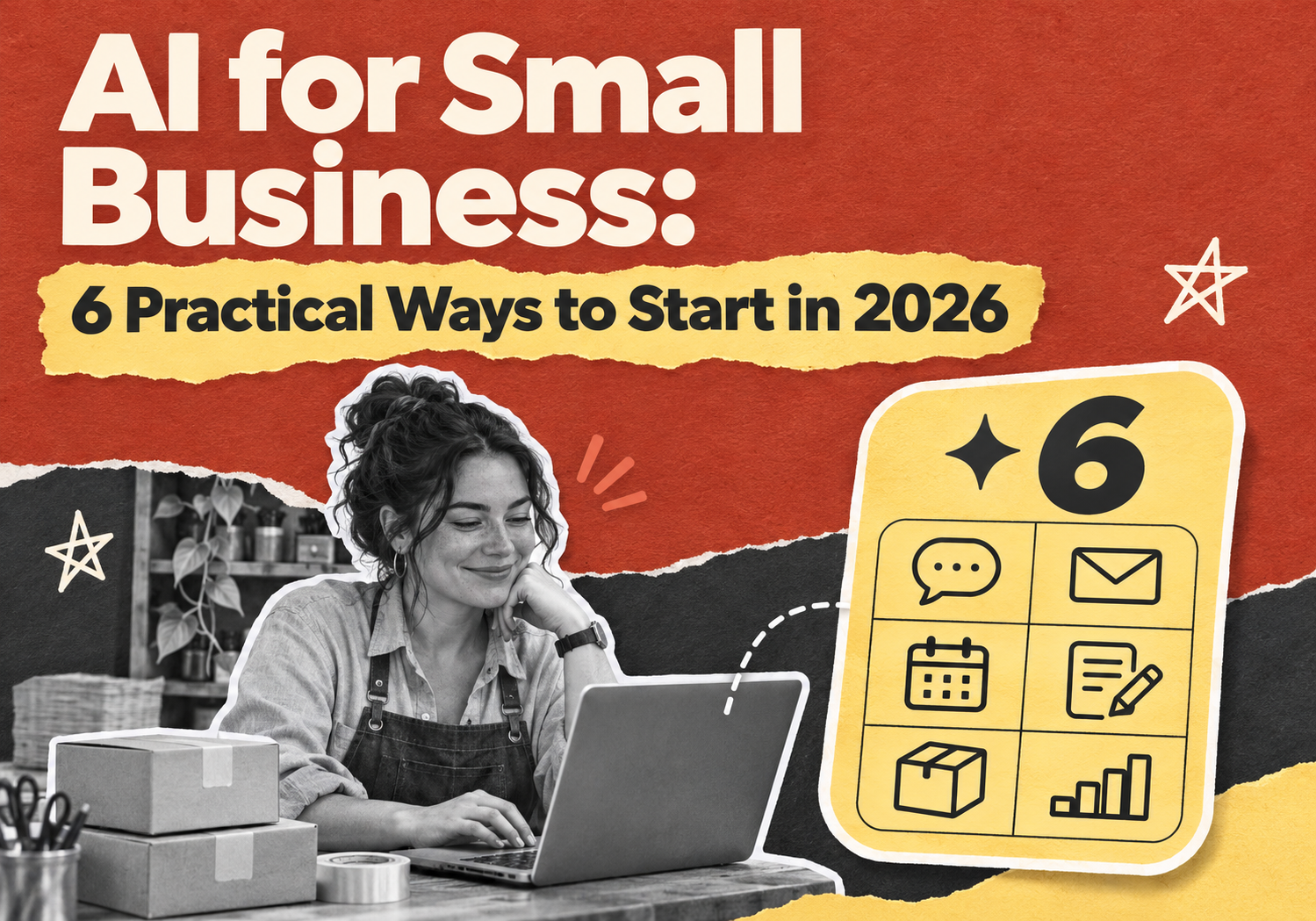
Start with the task your team complains about most, as long as a person can check the result before it goes out. Here are six places we'd look first, roughly from easiest to hardest.
1. Customer replies. Draft answers to common emails and chat questions, then let a person review and send. Great for order status, hours, returns and pricing questions.
2. Marketing drafts. First drafts of product descriptions, social posts and blog outlines. A human should edit for accuracy and voice. Pair it with solid digital marketing so the content actually gets found.
3. Quotes and proposals. Turn your past proposals into a template the AI fills in from a short intake form.
4. Admin and bookkeeping prep. Sorting receipts, summarizing meeting notes, pulling key dates out of contracts.
5. Demand and inventory forecasting. This is real machine learning. It works when you have enough consistent history to see seasonal patterns, which usually means a year or more of records.
6. Product recommendations and site search. For online stores, smarter search and recommendations can help shoppers find what they want faster. This also needs good product and order data.
How much time can this save? One 2026 small business survey, as summarized by Self Employed, put it at about 5.6 hours a week for the average worker. Treat that as a rough guide, not a promise. Your number depends on the task.
Do you need machine learning, or is a chatbot enough?
If you're drafting, summarizing or answering questions, a ready-made tool is enough. Custom machine learning earns its cost only when you make the same decision over and over and have history to learn from.
Good signs you're ready for custom work:
- You repeat the same prediction every week, like how much stock to order.
- You have at least a year of consistent records in one place.
- A small improvement in accuracy would clearly save money or win sales.
- Someone on your team owns the result and will act on it.
No to most of those? Stick with off-the-shelf tools for now. There's no shame in it, and it's cheaper.
Why do most small business AI projects stall?
They stall because nobody owns them, the data is messy, or nobody decided what success looks like. The tools are rarely the problem. A 2026 report summarized by Self Employed says 70% of owners still want more training to use AI tools well, and the Chamber report says 95% of AI-using small businesses are working on upskilling their people.
Four habits help:
- Pick one task, not ten. A narrow pilot tells you quickly whether it works.
- Name an owner. One person is responsible for the result.
- Set a simple measure. Hours saved per week, response time, or error rate.
- Keep a human in the loop. Review anything customer-facing before it goes out.
How do you keep customer data safe when using AI?
Treat AI tools like any vendor that touches customer information: know what you share, and read the data terms first. A few ground rules cover most small businesses.
- Don't paste customer personal details into free consumer tools.
- Check whether a vendor uses your inputs to train its models, and what you can switch off.
- Keep a short list of which AI tools your team uses and for what.
- Review AI output before it reaches a customer.
If you do business in Texas, there's a new law to know about. According to a Haynes Boone summary, the Texas Responsible AI Governance Act took effect January 1, 2026. Only the Texas Attorney General can enforce it, there is a 60-day cure period, and following a recognized framework such as the NIST AI Risk Management Framework can give you a safe harbor from civil penalties. NIST's framework is voluntary and was first released January 26, 2023. That summary comes from a law firm, not the statute, so check with your attorney about your own situation.
How can 10Native help with AI for your business?
We help business owners pick one worthwhile use case and build it properly. 10Native's AI and machine learning team works on practical projects, and our data engineering services get your data into shape so the models have something solid to learn from. If your goal is more customers, our digital marketing and e-commerce teams can connect AI work to your site, your Shopify store and your search visibility.
A few honest limits. We can't promise a specific return, because it depends on your data and your team. We won't sell you custom machine learning if a ready-made tool does the job. A good first conversation should end with one use case, a rough scope and a straight answer on whether you need custom work at all.
Not sure where AI fits in your business? Tell us the task that eats your week and we'll tell you honestly what would help.
Talk to 10NativeFrequently asked questions
How much does AI cost for a small business?
Will AI replace my employees?
What is the difference between AI and machine learning?
Do I need clean data before using AI?
Is it safe to put customer information into an AI tool?
How long until I see results from AI?
Can 10Native help my business get started with AI?
Ready to try AI without the guesswork? Call us at 415 489 9314 or 214 758 7971, or email info@10native.com. We'll help you pick a starting point that fits your business and your budget.
Let's find the one task AI can take off your plate.
Get in touch10Native Team
Building resilient enterprise solutions in AI/ML, Data Engineering, Fintech & Digital Marketing.