Organic SEO vs Google Ads: Which Is Better for a Small Business?
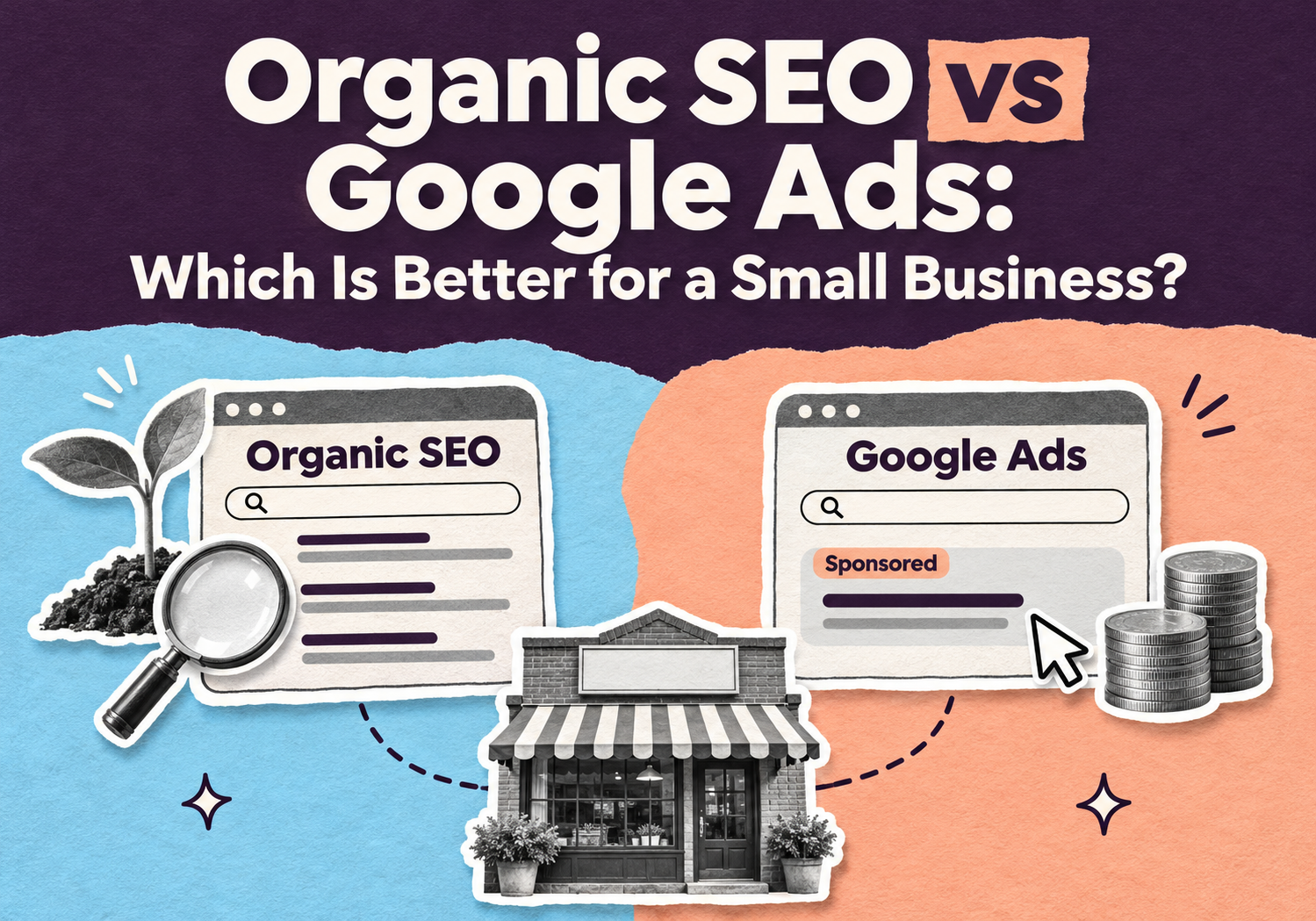
Organic SEO or Google Ads: which one should a small business pay for first? For most businesses the honest answer is both, in different amounts, for different jobs. Google Ads buys you visitors this week. Organic SEO builds visitors you don't pay for every click. The right mix depends on your budget, how fast you need leads, and how many people already search for what you sell.
This guide compares the two on cost, speed and risk, explains what Google's AI Overviews have changed, and gives you a simple way to split your budget. It's written for owners, not marketers.
What is the real difference between organic SEO and Google Ads?
Organic SEO earns unpaid rankings in Google's results. Google Ads pays for a spot at the top of them. That's the whole difference, and it drives everything else.
- Google Ads: you bid on a search, you pay when someone clicks, and the traffic stops the day you stop paying.
- Organic SEO: you improve your pages, your content and your reputation, and a page that earns a ranking keeps earning visits without a per-click bill.
Think of ads as renting a storefront by the day and SEO as buying the building. Renting gets you open tomorrow. Buying costs more up front in time and effort, and it's yours afterward.
If you want the longer version of how organic work is done, see our guide to organic SEO services.
Which one costs less for a small business?
Organic SEO usually costs less per visit over time, but you pay for it before it pays you back. Google Ads costs you on every click, and clicks are getting pricier.
Here's what the 2025 benchmarks show. WordStream by LocaliQ reviewed more than 16,000 campaigns and found the average Google Ads cost per click rose to $5.42 in 2025, up from $4.66 the year before. About 87% of the industries it analyzed saw costs go up. Conversion rates were healthier, averaging 8.18%, so the clicks you pay for do turn into leads. They just cost more to get.
Online stores are feeling it too. Channable, an e-commerce ad platform, analyzed about 1.38 billion euros of Google Ads spend from more than 10,000 European advertisers and reported on July 12, 2026 that cost per click on Shopping and Performance Max campaigns was up 15% year over year. Return on ad spend fell 46% on Performance Max and 43% on standard Shopping. That's European data, so treat it as a direction rather than a promise for your store. But the direction is clear.
The catch with SEO: the bill arrives early. You pay for content, site fixes and ongoing work for months before rankings move.
Which one is faster?
Google Ads is faster. A new campaign can send traffic within days, while organic rankings build over time and can't be switched on. That's the biggest reason to run ads at all.
So if you have a deadline, ads are the tool. A holiday sale, a new location, a slow month you need to fix. Black Friday falls on November 27 this year and Cyber Monday on November 30. If your store isn't ranking for gift searches yet, new organic pages won't change that in three weeks. Ads can.
SEO is the better fit for the problem you'll still have next year: not showing up when people search for what you sell.
How do AI Overviews change the organic SEO vs Google Ads answer?
AI Overviews have cut clicks on both organic and paid results, and brands that get cited in them do better on both. This is the newest piece of the puzzle, and it's easy to get wrong.
Seer Interactive studied 3,119 informational searches across 42 organizations, from June 2024 to September 2025. On searches that showed an AI Overview, organic click-through rate fell 61%, from 1.76% to 0.61%. Paid click-through rate fell 68%, from 19.7% to 6.34%. So ads don't escape the effect.
Here's the useful part. Seer found that brands cited inside the AI Overview got 35% more organic clicks and 91% more paid clicks than brands that weren't cited. Being the source Google quotes helps your ads too.
A later Seer update covering 53 brands reported early signs of recovery, with the rate rising from 1.3% in December 2025 to 2.4% in February 2026. It's early data, so don't plan around it.
What does that mean for you?
1. Don't assume ads are a safe shortcut. They lose clicks to AI answers too.
2. Clear, well-organized content that answers real questions gives you a shot at being cited.
3. This applies mainly to informational searches. Someone typing a service plus a city is usually closer to buying, and that's where both channels still work hard.
When should you choose Google Ads first?
Choose ads first when you need leads now and have a clear offer. Ads make sense when:
- You're launching a new business or location with no rankings yet.
- You have a deadline, like a seasonal sale or an event.
- Your profit per customer is high enough to absorb a pricey click.
- You want to test which offers and keywords convert before investing in content.
Set a budget cap, track every lead, and watch your cost per lead rather than your clicks. Clicks are a vanity number if nobody calls.
When should you choose organic SEO first?
Choose organic SEO first when you can wait a few months and want steady, lower-cost traffic. SEO makes sense when:
- Your customers search before they buy, which is true for most service businesses and stores.
- Your margins are thin, so a $5 click is hard to justify.
- You plan to be around for years and want an asset that compounds.
- Your competitors are already ranking and you're invisible.
It also pays off beyond Google. The same clear pages that rank are the pages AI tools can understand and quote. If you serve a local area, local pages matter most. Our Austin SEO service shows how we approach that for Texas businesses.
Should a small business run both? A simple way to split the budget
Yes, if you can afford it. Use ads to cover the gap while SEO ramps up, then shift spend as organic traffic grows. Here's a simple way to start:
1. Month 1: Put most of the budget into ads for the searches that already convert, and start fixing your site and key pages.
2. Months 2 to 4: Keep ads running, but publish and improve the pages you want to rank for. Track which ad keywords bring real customers.
3. After that: Move budget toward SEO for the topics where you're starting to rank. Keep ads on high-value terms where you aren't.
4. Every month: Compare cost per lead from each channel and adjust.
The ad data pays you twice. It shows which search terms actually bring customers, and those same terms tell you what pages to build.
There's no single perfect ratio. A store with a big seasonal spike needs a different mix than a plumber who gets steady calls. Be wary of anyone who gives you a number without asking about your margins first.
How can 10Native help with organic SEO and Google Ads?
We can help you decide the split, then do the work on both sides. 10Native is a Texas LLC based in Prosper, with a production team that handles the build and content work. Here's what we can cover:
- Organic SEO and local SEO: page and content planning, on-page fixes and local pages for service businesses.
- SEO, AEO and GEO content: content structured so search engines and AI tools can understand and cite it.
- Paid ads and digital marketing: campaign setup and ongoing management as part of our digital marketing services.
- Website and store work: Shopify and WordPress design, speed and build, so the traffic you pay for or earn actually converts.
We'll also be straight about limits. Nobody can guarantee a ranking, and ad costs depend on your market and competitors. What we can do is look at your numbers, tell you where we'd put the money first, and show you what's working as we go.
Not sure whether to put your next dollar into ads or SEO? Talk to our team and we'll look at your site, your market and your goals with you.
Talk to 10NativeFrequently asked questions
Is organic SEO better than Google Ads?
How much does the average Google Ads click cost?
Do AI Overviews hurt Google Ads as well as organic results?
Can I stop paying for ads once my SEO starts working?
Which is better for Black Friday and the holidays?
What should a small business budget for SEO and ads?
Can 10Native guarantee first-page rankings or a set number of leads?
Ready to figure out the right mix? Call us at 415 489 9314 or 214 758 7971, or email info@10native.com. We'll tell you plainly where we'd start.
10Native Team
Building resilient enterprise solutions in AI/ML, Data Engineering, Fintech & Digital Marketing.