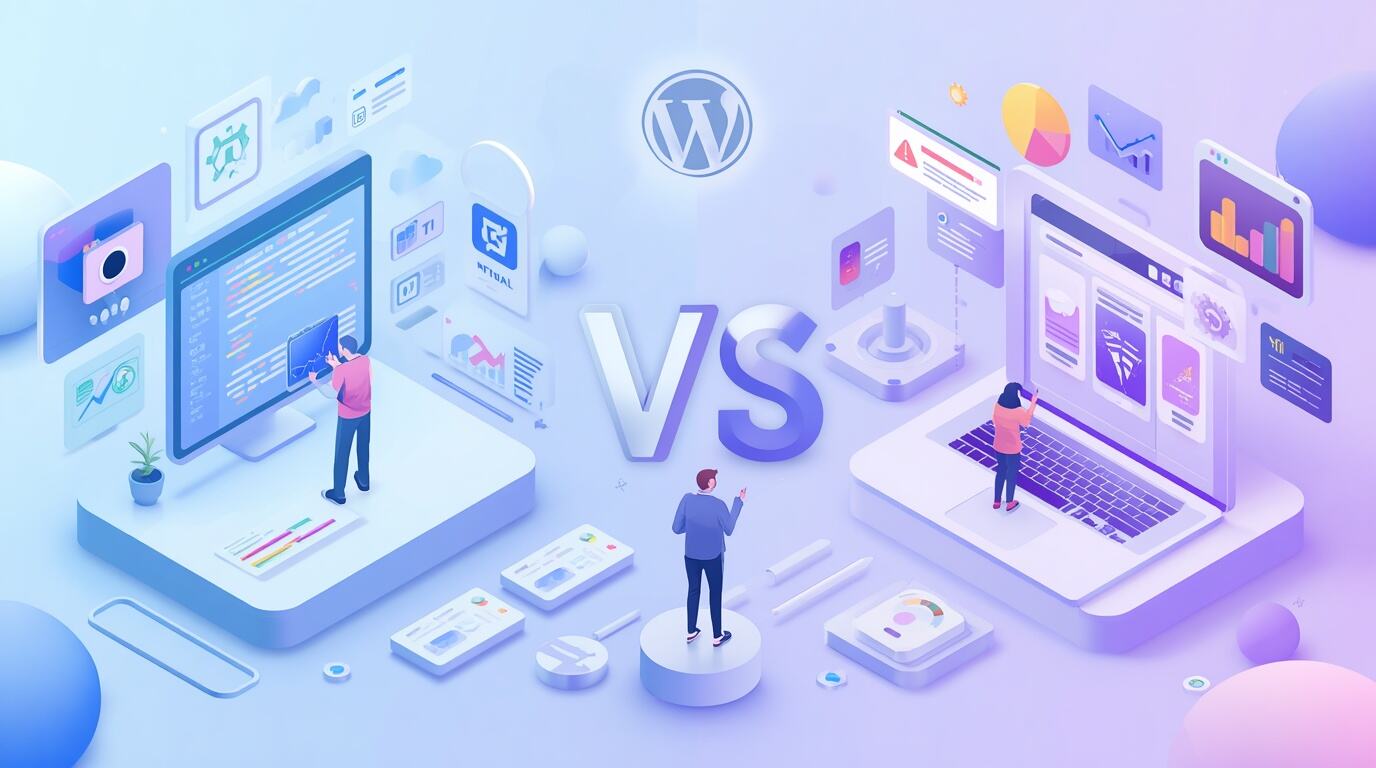
Custom WordPress Design vs Prebuilt Themes: Which Performs Better?
During the last decade, thousands of growing businesses have gone through the same quiet disappointment.
A business finally launches its new website. Everything looks polished on launch day. The theme demo looked perfect in the preview. The homepage feels modern. The animations impress everyone internally.
Then six months pass.
Traffic stays flat. Conversions barely move. Developers struggle every time someone asks for a small change. Every plugin update breaks something else. Pages get slower instead of faster. Search visibility stalls just when it should be climbing.
The problem was never WordPress itself. WordPress powers a huge share of the internet for good reason. The real problem was assuming a business with real growth ambitions could scale forever inside the boundaries of a theme built to serve thousands of unrelated companies at once.
This is exactly the conversation we have with clients every week at 10Native, a wordpress web design and Development company that works with businesses across the United States who have outgrown their prebuilt themes and need something built around their actual goals. Whether a company is in New York, Los Angeles, Chicago, Dallas, Houston, Seattle, Austin, San Francisco, Miami, Atlanta, Denver, or Nashville, the pattern repeats. A theme gets a business to launch day. It rarely gets a business to its next stage of growth.
So which one actually performs better, a custom WordPress build or a prebuilt theme? The honest answer is that it depends on what stage a business is at and what it plans to become. This guide breaks down performance, SEO, conversions, scalability, security, maintenance, and AI search readiness in enough depth that the decision becomes obvious for your specific situation.
Confused between custom and prebuilt? Download our free side-by-side comparison guide and discover which option truly delivers better results for your business.
Get Your Design Comparison GuideWhy This Decision Is Bigger Than Design
Choosing between a custom WordPress website and a prebuilt theme is not a visual decision. It is an infrastructure decision that determines how fast your site loads, how well it ranks, how easily it converts visitors, and how much it costs to maintain for years to come.
A theme is a piece of software built to satisfy the widest possible audience. That means it ships with page builders, shortcodes, animation libraries, multiple layout options, and dozens of features most buyers will never touch. All of that code loads in the browser whether it is used or not. A custom WordPress architecture, by contrast, is built only with what a specific business actually needs, which is why performance-first development consistently outperforms generic multipurpose themes on real world benchmarks.
This single difference cascades into everything else: Core Web Vitals, semantic HTML quality, accessibility, security surface area, and even how well an AI system like Google AI Overviews or ChatGPT can understand and cite your content.
What Actually Happens Inside a Prebuilt Theme
Prebuilt themes trade short term convenience for long term technical debt, and that debt shows up as slower pages, harder maintenance, and weaker rankings over time.
Most premium multipurpose themes are built around a page builder plugin that generates bloated markup behind the scenes. A simple two column layout that a custom developer could build with fifteen lines of clean semantic HTML often becomes hundreds of lines of nested divs, inline styles, and unnecessary JavaScript inside a theme builder.
Search engines and AI crawlers both prefer clean, meaningful structure. Bloated markup makes it harder for both to understand what a page is actually about.
Theme Dependency and Vendor Lock In
Once a business builds its content, forms, and layouts entirely around a specific theme or page builder, moving away from it later becomes painful. Every custom field, every shortcode, and every layout element is tied to that theme's ecosystem. If the theme developer stops updating it, or the license lapses, the business is stuck rebuilding from scratch. This is theme dependency, and it is one of the most overlooked risks in prebuilt WordPress websites.
Hidden Maintenance Costs
A theme that seemed inexpensive at checkout often becomes expensive over its lifetime. Businesses commonly end up paying for the original theme license, a page builder license, five or six premium plugins to patch missing functionality, and ongoing developer hours just to keep everything compatible after WordPress core updates. These hidden maintenance costs rarely show up in the initial pitch, but they show up every year on the invoice.
Plugin Conflicts and Technical Debt
Multipurpose themes are built to be compatible with almost everything, which paradoxically makes them fragile. Stacking plugins for forms, SEO, caching, security, and page building on top of a heavy theme creates a fragile web of dependencies. One update to any single piece can break the layout, disable a feature, or introduce a security gap. Over time this technical debt compounds and makes every future change slower and riskier.
Don't choose blind—get the exact performance checklist we use to evaluate WordPress designs. Fill in your details and make the right call today.
Send Me the Performance ChecklistHow Custom WordPress Development Changes the Equation
Custom WordPress architecture is built around exactly what a business needs today and what it plans to need in three to five years, which is why it consistently wins on speed, flexibility, and long term cost.
At 10 Native, custom builds start from a business goal rather than a theme demo. That means:
- Clean, minimal, semantic HTML that browsers, search engines, and AI systems can parse quickly and accurately
- Only the CSS and JavaScript the site actually uses, which directly improves LCP, INP, and CLS scores in Core Web Vitals
- Custom Gutenberg blocks built for the client's actual content types instead of generic page builder modules
- A content structure designed around real search intent and topical authority from day one
- Security hardened around the specific plugins and integrations in use, rather than a sprawling, generic attack surface
This is the same performance-first philosophy behind our Best Online Shopify web development services and our broader Custom Web development Services online, where every build starts with the business model, not a template.
Custom WordPress vs Prebuilt Themes: Direct Comparison
| Factor | Prebuilt Theme | Custom WordPress Development |
|---|---|---|
| Initial cost | Lower upfront | Higher upfront |
| Long term cost | Often higher due to plugins, fixes, and rebuilds | Lower over 3 to 5 years |
| Page speed | Slower due to bloated code | Faster, built lean |
| Core Web Vitals | Often fails LCP and INP | Built to pass by design |
| SEO ceiling | Limited by theme structure | Built around search intent |
| AI search readiness | Weak semantic structure | Clean, AI-readable architecture |
| Scalability | Breaks down as needs grow | Designed to grow with the business |
| Security | Broader, generic attack surface | Hardened around actual usage |
| Customization | Limited to theme options | Unlimited, business specific |
| Maintenance | Frequent, reactive | Predictable, proactive |
| Best suited for | Very early stage, low budget launches | Growing businesses, enterprise, long term brand investment |
Why Performance and SEO Are Inseparable in 2026
Google, Bing, and AI answer engines all use page experience signals as ranking and citation inputs, so a slow, bloated theme quietly caps how visible a business can ever become.
Core Web Vitals like LCP (Largest Contentful Paint), INP (Interaction to Next Paint), and CLS (Cumulative Layout Shift) measure how fast a page loads, how quickly it responds to a click or tap, and how stable the layout is while loading. Tools like Lighthouse, GTmetrix, and PageSpeed Insights turn these into scores anyone can check in minutes. Prebuilt themes routinely struggle here because they load builder frameworks, icon libraries, and animation scripts that have nothing to do with the actual content on the page.
Semantic HTML, proper heading hierarchy, structured data, and schema markup all help search engines and AI systems understand what a page means, not just what it says. This is the foundation of organic search engine optimization services done properly. A theme built for generic use rarely produces the kind of clean, meaningful markup that supports strong technical SEO or AI crawlability. A custom build can be architected around it from the first line of code.
Caching, a CDN, object caching, image optimization, lazy loading, and script deferral all compound on top of a lean codebase. Layer these optimizations onto a bloated theme and you get modest gains. Layer them onto a clean custom architecture and the results compound dramatically.
Still unsure which route is right for you? Request a free 15-minute consultation and we'll help you decide based on your goals, budget, and timeline.
Claim Your Free Design ConsultationWhy AI Search Changes What Websites Need to Look Like
Google AI Overviews, AI Mode, ChatGPT, Gemini, Claude, and Perplexity all read websites differently than a human scanning a page, which means the underlying code quality now directly affects whether a business gets cited at all.
These systems extract entities, relationships, and answer-ready passages from a page's structure. Clean semantic HTML, clear heading hierarchy, and well-organized content are far easier for these systems to parse and quote accurately. A page buried in div soup from a generic page builder is harder for an AI system to interpret with confidence, which reduces the odds of being surfaced in an AI Overview or conversational answer.
This is a genuinely new competitive advantage. Businesses that invest in AI-optimized WordPress websites now are positioning themselves for the next several years of search behavior, not just today's keyword rankings.
Why Users Trust Custom Websites More Than They Realize
Visitors form a judgment about credibility within seconds, and generic, recognizable templates quietly undermine that judgment even when visitors cannot articulate why.
This comes down to trust psychology and cognitive fluency. When a layout looks unique and feels effortless to navigate, the brain processes it as more credible, a bias researchers call the authority bias in digital contexts. When a visitor unconsciously recognizes a familiar theme layout from another site they have seen before, that instant recognition subtly damages perceived professionalism, even if they cannot name the theme.
Custom design also reduces decision fatigue. A visitor should never have to think about where to click next. Strong visual hierarchy, meaningful whitespace, and intentional emotional design guide attention naturally toward the action a business actually wants, whether that is a call, a form submission, or a purchase. This is the foundation of conversion-focused websites, and it is very difficult to achieve inside the rigid constraints of a theme built for a thousand unrelated industries at once.
We cover this in more depth in our guide on WordPress UX Design Best Practices for Higher Engagement, and the mistakes that undo this trust are detailed in 15 WordPress Design Mistakes That Hurt User Experience.
What Businesses at Different Stages Actually Need
The right choice depends heavily on business size, growth stage, and how central the website is to revenue, not on budget alone.
**Early stage or very small businesses.* A well chosen premium theme, kept lean and configured carefully, can be a reasonable starting point when budget is the primary constraint and the site's job is simply to establish an online presence.
Growing businesses with real marketing investment. Once a business is spending real money on ads, SEO, or content, a theme's performance ceiling starts costing more in lost conversions and rankings than a custom build would have cost outright. This is the stage where most of our clients come to us after their theme site plateaus.
**Enterprise and multi-location businesses.* Editorial workflows, governance, multiple content teams, complex integrations, and API-driven functionality require enterprise WordPress solutions and, frequently, headless WordPress architecture that a theme was never designed to support.
How to Decide: A Practical Framework
Ask these questions honestly before deciding:
- Is your website central to how the business generates revenue, or is it mostly informational?
- Do you expect meaningful organic search growth over the next two to three years?
- Will your content, product catalog, or functionality grow significantly in complexity?Item three
- Have you already outgrown a theme once before?
- Do you need custom plugins, API integrations, or a headless setup for a mobile app or other frontend?
- Is brand differentiation important in a competitive market?
Answering yes to three or more of these questions is a strong signal that custom WordPress website development will outperform a prebuilt theme on a three to five year horizon.
Stop second-guessing. Grab our complete decision toolkit with real performance data, cost breakdowns, and case studies—all in one place.
Get the Decision-Making ToolkitQuick Decision Checklist
- Revenue depends on the site: choose custom
- Budget under a few thousand dollars and site is a placeholder: theme may be acceptable short term
- Planning significant SEO investment: choose custom
- Need enterprise governance or multiple editors: choose custom
- Expect to migrate or scale within 12 months: choose custom from the start to avoid a costly rebuild
Why Outdated Agencies Still Sell Prebuilt Themes
Many agencies still default to generic premium themes and stack them with excessive plugins because it is faster and cheaper to deliver, not because it serves the client better long term. The result is websites with poor accessibility, weak Core Web Vitals, thin semantic SEO, and almost no AI search readiness.
10Native takes a different approach as an online Wordpress web development services provider: custom architecture from the first strategy call, semantic SEO built into the content structure, performance-first development at the code level, accessibility-first practices that satisfy WCAG guidance, and a search-first information architecture designed for both human readers and AI retrieval systems from day one.
Frequently Asked Questions
Is a custom WordPress website really better than a premium theme?
For any business planning meaningful growth, yes. Custom builds outperform on speed, SEO ceiling, security, and long term cost, even though the upfront investment is higher.
Are premium WordPress themes worth buying at all?
They can be a reasonable short term option for very early stage businesses with minimal budget, as long as expectations about performance and scalability limits are realistic from the start.
Which option performs better for SEO?
Custom WordPress development generally wins because it allows clean semantic HTML, faster Core Web Vitals, and content architecture built around real search intent rather than a generic template structure.
Which option converts better?
Custom design typically converts better because it removes friction, reduces decision fatigue, and builds trust through intentional visual hierarchy rather than a recognizable, generic layout.
Should I use a custom WordPress website or a premium theme?
For a business planning long term growth, a custom WordPress website usually performs better on speed, search visibility, and total cost over several years.
Are WordPress themes bad for SEO?
Not inherently, but many prebuilt themes include bloated code that slows pages down and weakens Core Web Vitals, which can hold back search rankings over time.
What does a wordpress web design and Development company actually do?
A wordpress web design and development company designs, builds, and maintains custom WordPress websites tailored to a specific business rather than relying on generic templates, focusing on performance, SEO, and long term scalability.
When should a business invest in custom WordPress development instead of a theme?
As soon as the website becomes central to revenue, marketing investment increases, or the business has already outgrown the limitations of a theme once before.
One option outperforms the other for most businesses—find out which. Enter your details and get instant access to our expert analysis.
Unlock the Right Choice NowConclusion: Treat This as a Growth Decision, Not a Design Choice
The comparison between custom WordPress design and prebuilt themes ultimately comes down to one question: is your website a short term placeholder or a long term growth asset? A theme can get a business online quickly. It rarely gets a business through years of scaling, evolving SEO demands, and the shift toward AI-driven search.
Working with an experienced wordpress web design and development company means building on an architecture engineered for speed, accessibility, semantic clarity, and AI readiness from day one, rather than retrofitting those things onto a template years later. That is the difference between a website that simply exists and one that keeps performing, ranking, and converting as your business grows.
At 10Native, this is the foundation of every project we take on, whether a business needs a full custom WordPress rebuild, ongoing organic search engine optimization services, or a scalable framework built to support growth for years to come.
Your website's foundation matters. Share your details and we'll send you the proven framework to choose the perfect WordPress setup for your needs.
Start Building Smarter Today10Native Team
Building resilient enterprise solutions in AI/ML, Data Engineering, Fintech & Digital Marketing.