How Does Search Engine Optimization Actually Work?
A business owner publishes a new service page on a Tuesday afternoon. By Friday, she checks Google Search Console out of curiosity and sees something that does not quite add up. Impressions are climbing. The page is showing up in search results more than it did last month. But clicks are barely moving. The page exists. Google clearly knows about it. Customers, on the other hand, are not finding their way to it.
This is one of the most common and most confusing moments in running a website, and it is exactly where hiring a team for Search Engine Optimization Services starts to make a lot more sense than reading another list of generic tips. Most business owners already understand, at a surface level, that SEO helps a website appear on Google. Far fewer understand what is actually happening in the gap between publishing a page and earning a click, and that gap is where real Search Engine Optimization Services earn their value. That mechanism, the full chain of events between hitting publish and showing up for the right person at the right moment, is what this guide is going to unpack.
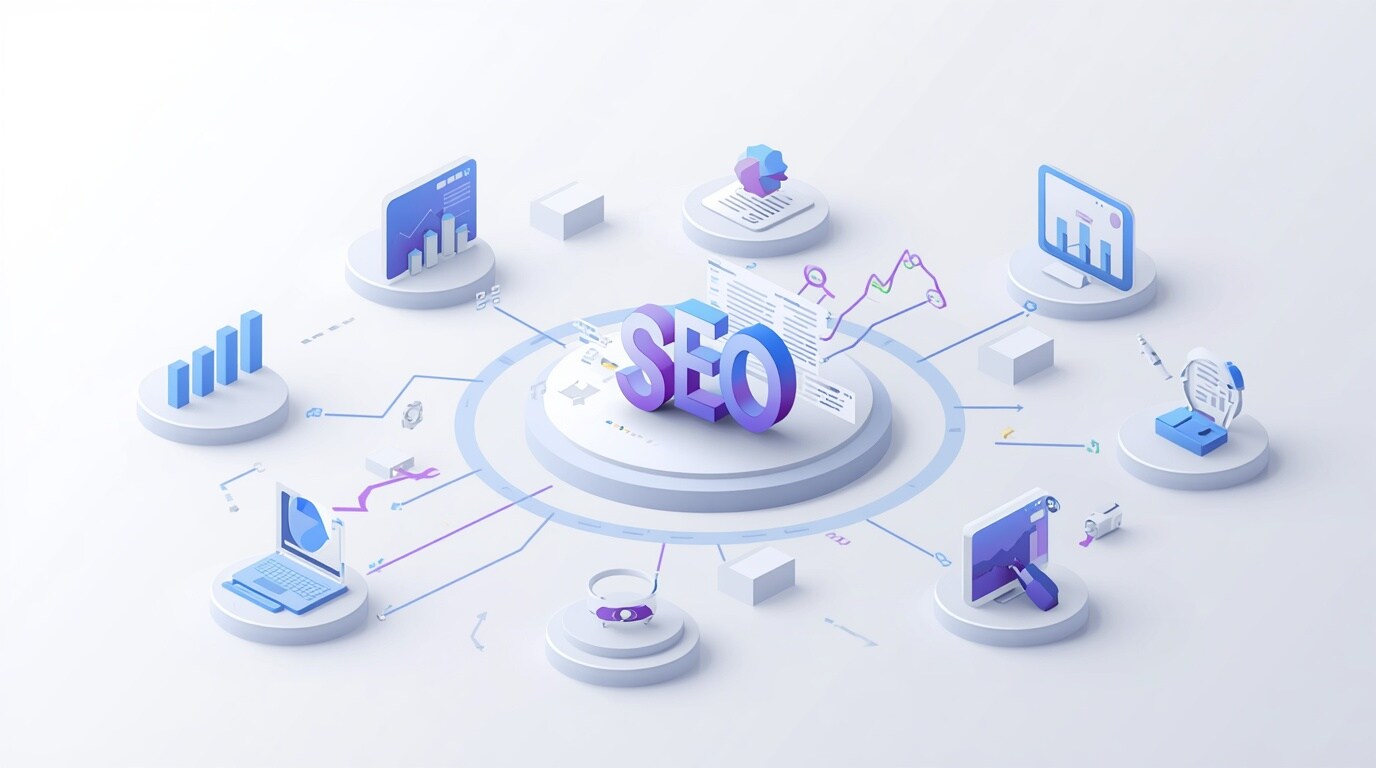
SEO works by helping search engines discover, crawl, understand, and evaluate a webpage, then match it against what a person is actually trying to accomplish with their search. It blends technical accessibility, content relevance, search intent alignment, site authority, and user experience into a set of signals search engines use to decide which pages deserve visibility, and then it depends on the searcher actually choosing to click.
Below is the quick version. The rest of the article breaks each stage down properly.
Demystify SEO once and for all. Get our free SEO cheat sheet and understand exactly how search engines rank your pages.
Get Your SEO Cheat SheetThe Path From Publish To Click
- Discovery. Google has to find that a page exists, usually through links, sitemaps, or previously known URLs.
- Crawling. Googlebot visits the page and reads what is there.
- Rendering. For JavaScript-heavy pages, Google has to build the page the way a browser would before it can understand it.
- Indexing. The page gets stored in Google's index, which is a prerequisite for ranking, not a guarantee of it.
- Understanding. Google interprets the words, structure, entities, and context of the page.
- Relevance matching. Google compares the page against a specific query and the intent behind it.
- Ranking. The page is positioned relative to competing pages for that query.
- SERP presentation. How the result looks (title, snippet, rich results) affects whether someone clicks.
- User interaction. The visitor's experience on the page determines whether the visit turns into anything.
- Business outcome. Leads, sales, calls, or bookings, which is the actual point of doing any of this.
Most explanations of SEO stop at step 6 or 7. That is why so many websites rank, get impressions, and still do not grow.
How Does Google Discover A New Website?
Before a page can rank for anything, Google has to know it exists. Discovery happens through a handful of predictable paths: links from other pages Google already knows about, XML sitemaps submitted through Search Console, internal links from other pages on the same site, and in some cases direct submission through Search Console's URL inspection tool.
This is where a lot of otherwise good content quietly disappears. An orphan page, meaning a page with no internal links pointing to it, can sit on a website for months without ever being noticed. Broken internal links break the trail Google follows to find new content. A misconfigured robots.txt file can block entire sections of a website without anyone realizing it. And a stray noindex tag left over from a staging environment can keep a perfectly good page out of the index entirely.
None of these are rare mistakes. They show up constantly in audits, which is part of why an Expert SEO Audit Agency spends so much of its time simply checking whether a website's architecture allows Google to find everything that matters in the first place.
How Crawling Actually Works
Once Google knows a URL might exist, it sends Googlebot to visit it. Crawling is essentially Google reading the page the same way a browser would, following links, checking headers, and noting what content is present.
For small websites, crawling is rarely a bottleneck. For large ecommerce catalogs, crawl budget becomes a real constraint. If a site generates thousands of duplicate or parameterized URLs (filtered product listings, sort orders, session variables), Google can spend its limited crawl budget on low-value pages instead of the ones that actually matter. Clean internal linking, well-structured XML sitemaps, and sensible URL parameters all help direct crawlers toward the pages worth prioritizing.
JavaScript-heavy websites add another layer of complexity. If critical content only appears after JavaScript executes, Google needs to render the page before it can read that content, and rendering happens on a delay separate from the initial crawl. A page that looks complete in a browser can look nearly empty to a crawler that has not yet rendered it.
Why Does Google Index Some Pages But Ignore Others?
Being crawled and being indexed are not the same thing, and this distinction trips up more businesses than almost anything else in SEO.
The index is essentially Google's massive, searchable database of pages it has decided are worth storing and potentially serving to users. A page can be crawled successfully and still never make it into the index, or make it in and later be dropped.
Common reasons a page gets excluded include thin or low-value content that does not add anything beyond what already exists elsewhere, duplicate content that overlaps heavily with another page on the same site, canonicalization pointing Google toward a different version of the page as the primary one, and explicit noindex directives.
Here is a simple example. An ecommerce store creates a landing page for every possible product color and size combination. Each page has nearly identical content with one word changed. Google may crawl all of them, decide they are duplicates of each other, and only index one or two, effectively ignoring the rest no matter how much effort went into creating them.
Indexed does not mean ranked, and it definitely does not mean visible for the queries that actually drive revenue. A page can sit in the index for a low-competition, low-value query while never showing up anywhere near the first page for the terms a business actually cares about.
What Makes A Page Relevant To A Search?
This is where semantic SEO comes in, and it is less mysterious than it sounds. Search engines interpret pages by analyzing the words used, the topics those words point to, the entities involved (people, places, brands, products, concepts), the structural signals like headings and internal links, and any structured data that explicitly labels what the content is about.
Google is not simply matching exact keywords anymore. It is building a picture of what a page is about and how confidently that page answers a given query. A page about running shoes that only ever repeats the phrase running shoes without ever discussing cushioning, terrain, foot type, or brand comparisons looks thin compared to a page that naturally covers the related concepts a person actually cares about when researching running shoes.
This is also why keyword density, as a strategy on its own, stopped being useful a long time ago. Repeating a phrase does not deepen relevance. Covering the topic thoroughly does.
Confused about algorithms and rankings? Fill in your details and get our plain-English guide to how SEO really works no jargon, just clarity
Send Me the Beginner's GuideHow Do Ranking Systems Actually Evaluate Pages?
There is no single formula. Google has been explicit for years that it uses many different ranking systems working together, and which signals matter most shifts depending on the query itself. A local plumbing search leans heavily on proximity and Google Business Profile signals. A competitive national ecommerce query leans on authority, product data, and user experience. A niche informational query leans on topical depth and first-hand expertise.
Broadly, ranking systems weigh relevance to the query, the overall quality and helpfulness of the content, the authority and trustworthiness of the site and the specific page, the experience the page provides once someone lands on it, and contextual factors like location, device, and sometimes freshness.
Search intent sits underneath almost all of this. The four commonly recognized intent categories are informational (someone wants to learn something), navigational (someone wants a specific site or page), commercial investigation (someone is comparing options before buying), and transactional (someone is ready to take action). A page can contain the exact right keyword and still rank poorly if it satisfies the wrong intent. A product page targeting a query where searchers actually want a buying guide will struggle no matter how well the product page itself is built, because it is answering a different question than the one being asked.
How Do Technical SEO Services Support Visibility?
Technical SEO is the foundation everything else sits on. If Google cannot reliably crawl, render, and index a site, the best content in the world will not matter.
Good Technical SEO Services focus on crawlability and indexability, clean site architecture that makes important pages easy to find, page speed and Core Web Vitals, mobile usability, correct canonical tags, clean redirect handling, HTTPS security, structured data implementation, JavaScript rendering issues, XML sitemap accuracy, and internal linking that distributes authority to the pages that matter most.
None of this needs to sound like developer jargon to a business owner. In practical terms, technical SEO is about removing the friction between a search engine and a business's most valuable pages. A slow-loading site, a confusing URL structure, or a mobile experience full of layout shifts all quietly suppress visibility even when the content itself is strong.
How Do On-Page Services USA Improve Relevance?
If technical SEO is the foundation, on-page SEO is the part of the house people actually walk through. On Page Services USA typically focus on title tags and meta descriptions that clearly signal what a page offers, a logical H1 and H2 hierarchy, alignment between the page's content and the intent behind the target query, content structure that is easy to scan, internal links that connect related topics, image optimization including descriptive alt text, entity relationships that reinforce what the page is about, thorough topic coverage, and clear pathways toward conversion.
On-page work is really about translation. It helps both search engines and human readers understand a page's purpose quickly, without forcing either one to guess.
What Does An SEO Audit Actually Reveal?
A genuine Expert Seo Audit Agency does not hand over a generic checklist. A useful audit investigates technical errors and crawl issues, indexation problems, overall search visibility trends, keyword cannibalization (where multiple pages on the same site compete against each other for the same query), content gaps competitors are filling and a business is not, internal linking weaknesses, backlink profile quality, Core Web Vitals performance, mobile usability, structured data coverage, search intent misalignment, competitor visibility in the same market, and where conversion pathways are breaking down after the click.
A useful audit tells a business owner, in plain language, what is actually holding a website back rather than producing a wall of scores nobody can act on.
Get an SEO Strategy Review if impressions are climbing but clicks and conversions are not following.
Still not sure where your site stands? Request a free 15-minute SEO strategy session and we'll explain what's working for your niche.
Claim Your Free SEO Strategy CallHow Do Backlinks Contribute To Authority?
A backlink is simply another website linking to yours. Search engines treat links, particularly editorial ones earned rather than purchased, as a signal of trust and authority. A relevant link from a respected industry publication carries far more weight than dozens of low-quality directory links.
Digital PR, genuine brand mentions, and earned editorial coverage tend to build the kind of link profile that holds up over time. Buying large volumes of low-quality links is risky, both because Google's spam systems are built specifically to detect unnatural link patterns and because those links rarely carry any real relevance or authority in the first place.
It is worth being direct here: backlinks matter, but they are one input among many, not a magic lever that overrides weak content or poor technical health.
How Does Local SEO Work?
Local SEO shifts the priorities. A fully optimized Google Business Profile, consistent business name, address, and phone number (commonly shortened to NAP) across the web, location-specific landing pages, genuine customer reviews, local citations, and links from locally relevant sources all feed into whether a business shows up in the Map Pack and local organic results.
Local intent also changes how content should be built. A plumbing company competing for seo services in Brentwood is dealing with a very different competitive landscape than a national ecommerce brand. Local searchers are often closer to a transactional decision, and proximity plus trust signals like reviews carry disproportionate weight.
The same logic applies across markets. A business investing in Indianapolis SEO services needs location-specific pages that speak to that market's search behavior, not a single generic service page trying to rank everywhere at once. A Charleston SEO Company working with tourism-driven or seasonal businesses has to account for search demand that shifts throughout the year in a way a purely national business would not.
How Does National SEO Differ From Local SEO?
National SEO trades proximity signals for scale, depth, and authority. Search demand is broader, competition is fiercer, and ranking usually requires deeper topical coverage, stronger digital PR, and a more developed content cluster strategy rather than a handful of location pages.
A complete guide to seo services for local and national growth in New York, for example, has to account for the fact that New York is simultaneously a hyperlocal market at the neighborhood level and a nationally competitive market for many industries. The strategy that works for a Brooklyn dentist looks nothing like the strategy that works for a New York-based SaaS company competing nationally.
Market differences show up everywhere once you look for them. Understanding what makes an seo company in Seattle truly effective in 2026 means understanding Seattle's concentration of tech and enterprise buyers, which pushes content strategy toward more technical depth and commercial investigation content. Meanwhile, what makes seo services Dallas different often comes down to Dallas's mix of fast-growing local industries and steep competitive density in sectors like real estate, healthcare, and professional services, which changes how aggressive a link building and content strategy needs to be to stand out.
How Does Ecommerce SEO Work?
Ecommerce introduces its own set of mechanics. Product pages and collection pages need to be structured so that search engines can distinguish primary listings from filtered or duplicate variations. Faceted navigation, while useful for shoppers, can generate enormous numbers of near-duplicate URLs if it is not handled carefully with canonical tags and parameter controls.
Product schema markup helps search engines understand price, availability, and reviews well enough to sometimes surface rich results directly in the SERP. Genuine customer reviews add both trust signals and fresh, unique content to otherwise templated product pages. Internal linking between related products and categories helps distribute authority and helps shoppers (and crawlers) move through the catalog logically.
Ecommerce queries also split cleanly across intent types. Someone searching a broad product category is usually in commercial investigation mode, comparing options. Someone searching a specific product name with the word buy or a specific size attached is deep in transactional intent. A basic shopify seo checklist ecommerce growth strategy should account for both of these, structuring category pages for comparison-stage searchers while optimizing product pages for the searchers ready to purchase.
How Do UX And SXO Affect Search Performance?
SEO does not end the moment someone clicks a result. Search Experience Optimization, or SXO, treats the click as the beginning of the evaluation, not the end of it.
Page speed, mobile usability, readable content structure, clear information architecture, low-friction paths to the next step, obvious calls to action, and visible trust signals all influence whether a visit turns into anything meaningful. Google's page experience signals reflect part of this, but the business impact goes well beyond rankings. A page that ranks in position three with a strong, fast, well-structured experience can outperform a page ranking in position one that loses visitors to slow load times or confusing navigation.
See What Is Holding Your Rankings Back before assuming the fix is always more content or more links.
How Are AI Overviews Changing Search?
Google's AI Overviews, along with the growing use of ChatGPT, Gemini, and Perplexity for research-style queries, are changing where the click happens, and sometimes whether it happens at all. For some queries, a searcher gets a synthesized answer directly on the results page and never visits a website.
This does not make traditional SEO irrelevant. AI systems still need to identify, evaluate, and pull from sources, and the sources with clear, well-structured, evidence-backed answers, strong entity relationships, and legitimate first-hand expertise are the ones most likely to be pulled into those synthesized answers or cited directly. There is no reliable technique that guarantees a citation in an AI-generated answer, and any claim otherwise should be treated with skepticism. What consistently helps is writing content that answers questions clearly, backs claims with real sourcing, and organizes information in a way that is easy for a machine to parse and a human to trust.
How Do GEO And AEO Fit Into Modern SEO?
Two newer terms are worth defining clearly, because they are often misunderstood as replacements for SEO rather than extensions of it.
Generative Engine Optimization, or GEO, focuses on visibility within AI-generated, synthesized search experiences. Answer Engine Optimization, or AEO, focuses on structuring content to directly answer specific questions, the kind that show up in featured snippets, People Also Ask boxes, and voice search results.
The relationship works something like this: SEO builds the foundation of discoverability and search visibility. AEO shapes content to directly satisfy question-based queries. GEO extends that visibility into generative, AI-summarized experiences. SXO makes sure that once someone does land on a page, whether from a traditional result or an AI citation, the experience holds up. None of these operate independently. A page with weak technical SEO is unlikely to perform well in AI Overviews no matter how well the content itself is written, because discovery and indexing still have to happen first.
Stop guessing and start knowing. Grab our step-by-step SEO blueprint that breaks down exactly how search engines find, crawl, and rank your content.
Get the SEO BlueprintCommon SEO Misconceptions Worth Retiring
SEO is just keywords. Keywords matter for understanding demand and intent, but modern ranking systems evaluate topical depth, entity relationships, and user satisfaction well beyond keyword placement.
More content always means better rankings. Publishing volume without genuine usefulness tends to dilute a site's overall quality signals rather than strengthen them.
Ranking number one guarantees revenue. A top ranking for the wrong query, or a page that fails to convert once visitors arrive, produces visibility without business results.
Backlinks are the only important factor. Backlinks are one input among many. A technically broken or irrelevant page will not outrank a well-optimized competitor just because it has more links.
Technical SEO is only for developers. Technical issues have direct business consequences, and understanding them (even at a high level) helps business owners ask better questions and evaluate the work being done.
AI has made SEO irrelevant. AI search tools still rely on crawling, indexing, and evaluating sources. The mechanics have expanded, not disappeared.
Publishing more frequently automatically increases rankings. Consistency helps, but only when paired with genuine usefulness and depth.
Meta descriptions directly control rankings. They influence click-through rate from the SERP, not ranking position itself.
One SEO audit fixes everything. An audit identifies problems. Fixing them, and then continuing to optimize as competitors and algorithms shift, is an ongoing process.
SEO should produce immediate results. Search engines need time to crawl, index, evaluate, and build enough confidence in a page or site to rank it consistently.
How Long Does SEO Take To Work?
There is no universal timeline, and any agency promising a fixed number of weeks to a top ranking is oversimplifying a process that depends on too many variables to predict precisely.
The first 30 days are typically spent on technical fixes, audits, and foundational on-page work. Meaningful ranking movement is uncommon this early, though indexing improvements and early visibility shifts can show up.
30 to 90 days often bring early traction, particularly on lower-competition terms, as technical and content improvements start being recognized.
3 to 6 months is where more competitive terms typically start to show measurable movement, assuming consistent execution.
6 to 12 months is a realistic window for a site with real authority challenges, a competitive market, or significant technical debt to see substantial results.
Timelines shift based on competition level, the website's existing history and authority, technical health at the start, content quality, overall search demand for the target terms, the geographic market, existing backlink profile, and how quickly recommendations actually get implemented.
How Should Businesses Measure SEO ROI?
Rankings and traffic are useful diagnostic signals, but they are not the goal. The goal is business outcomes, and it is entirely possible to grow traffic while revenue stays flat, or to grow revenue while overall traffic barely moves because the traffic quality improved.
Worth tracking alongside rankings: organic traffic, but specifically qualified organic traffic relevant to what the business sells, leads generated, actual revenue and conversion rate, assisted conversions where organic search played a role earlier in the buyer journey, customer acquisition cost compared to other channels, customer lifetime value from organically acquired customers, non-brand traffic growth (a good indicator of genuine new visibility rather than people already searching for the brand by name), and for local businesses, direction requests, calls, and other local actions.
More traffic is not automatically better business. A page attracting a flood of visitors with zero commercial intent can look impressive in an analytics dashboard while contributing nothing to revenue. This is exactly why Google Search Console and GA4 need to be read together, not in isolation, when evaluating whether SEO work is actually paying off.
Four Realistic Examples Of How This Plays Out
A local service business (say, an HVAC company) starts with decent content but a Google Business Profile that has been neglected for years and inconsistent NAP information across directories. The mechanism at play is local trust and proximity signals. After cleaning up citations, actively managing reviews, and building out service-area pages, the expected impact is improved Map Pack visibility and more calls from nearby, ready-to-book searchers, typically within a few months given how directly local signals connect to local intent.
An ecommerce store has strong products but faceted navigation generating thousands of duplicate URLs, spreading crawl budget thin. The mechanism is technical SEO and crawl efficiency. After implementing canonical tags, cleaning up parameter handling, and strengthening category-level internal linking, the expected impact is more efficient crawling of high-value product and category pages, which over time supports better indexing and visibility for commercial and transactional queries.
A B2B company has authoritative expertise but almost no structured content addressing the specific questions its buyers research before a sales call. The mechanism is search intent alignment and topical authority. After building content around genuine commercial investigation queries and reinforcing internal linking between related resources, the expected impact is more qualified organic traffic entering earlier in a longer B2B buying cycle, supporting sales rather than replacing it.
A national service company ranks reasonably well already but suffers from slow page speed and a confusing mobile checkout flow. The mechanism is user experience and SXO. After addressing Core Web Vitals issues and simplifying the mobile conversion path, the expected impact is a higher conversion rate from the same traffic level, meaning revenue grows without rankings necessarily moving at all.
How 10 Native Approaches SEO
10 Native treats SEO as a connected system rather than a checklist of isolated tactics. That means technical SEO and search intent mapping happen alongside content strategy, not after it. It means semantic SEO and entity relationships are built into content structure from the start rather than layered on afterward. It means local SEO, ecommerce SEO, and AI search readiness are treated as distinct disciplines with their own mechanics, not variations of the same generic playbook.
Because visibility without conversion does not move a business forward, the work is built around conversion-focused optimization and continuous measurement rather than a one-time project that ends once a report gets delivered. Search engines keep evolving. A site's competitors keep publishing. Continuous optimization is not an upsell, it is simply how SEO actually has to work if the goal is sustained results rather than a temporary bump.
Request an SEO Audit to see exactly where a website's visibility is breaking down between impressions and revenue.
Frequently Asked Questions
How does SEO actually work for a small business?
For a small business, SEO works by making sure the website can be found, understood, and trusted by search engines for the specific queries local or niche customers are actually searching. That usually means solid technical health, clear on-page relevance, and (for local businesses) a strong Google Business Profile, rather than the large-scale content and link strategies national brands rely on.
How long does SEO take to work?
Most businesses start seeing early movement within 30 to 90 days, with more competitive terms typically taking 3 to 6 months or longer. Timelines depend heavily on competition, existing site authority, and technical health at the start.
Why is my website indexed but not ranking?
Being indexed only means Google has stored the page, not that it has judged the page competitive for a specific query. Poor relevance, weak content depth, low authority, or intent mismatch can all keep an indexed page from ranking for valuable terms.
What do Search Engine Optimization Services include?
Comprehensive Search Engine Optimization Services typically include technical SEO, on-page optimization, content strategy, local or ecommerce SEO depending on the business, backlink strategy, and ongoing performance measurement, all working together rather than as separate line items.
How do Technical SEO Services improve Google visibility?
Technical SEO Services remove barriers between search engines and a website's content, covering crawlability, indexability, site speed, mobile usability, structured data, and clean architecture, all of which affect whether Google can find and properly evaluate pages in the first place.
What are On Page Services USA?
On Page Services USA refers to optimizing individual page elements, titles, meta descriptions, heading structure, content relevance, internal linking, and intent alignment, so that both search engines and visitors quickly understand what a page offers.
How can I tell whether I need an Expert SEO Audit Agency?
If a website has stagnant or declining organic traffic, rising impressions without matching clicks, unclear technical health, or simply has never had a thorough review, an audit is usually the fastest way to identify what is actually holding performance back.
How does local SEO work?
Local SEO relies on Google Business Profile optimization, consistent business information across the web, genuine reviews, local citations, and location-relevant content to help a business appear in local organic results and the Map Pack.
Does SEO still work in 2026?
Yes. Search behavior has expanded to include AI Overviews and conversational search, but the underlying mechanics of discovery, relevance, authority, and user experience still determine visibility across both traditional and AI-driven search experiences.
Can SEO help generate leads and sales?
Yes, when it is measured properly. SEO that focuses only on traffic or rankings without tracking leads, conversions, and revenue is missing the actual point. Properly aligned SEO connects search visibility directly to qualified leads and sales.
SEO doesn't have to be a mystery. Share your details and we'll send you the visual breakdown that makes the whole process crystal clear.
Unlock SEO Clarity NowKey Takeaways
SEO is a connected system, not a single tactic: discovery, crawling, indexing, understanding, ranking, and conversion all have to work together. Being indexed does not mean being visible for valuable queries. Search intent often matters more than keyword usage. Technical health is the foundation everything else depends on. Local, national, and ecommerce SEO each require different strategies. AI Overviews and generative search have expanded how visibility works, not replaced traditional SEO. Rankings and traffic are diagnostic signals, not the actual goal. Real ROI comes from leads, conversions, and revenue. SEO requires continuous work because search engines, competitors, and user behavior never stop changing.
Conclusion
The gap between publishing a page and earning a customer is where most of the real work of SEO actually happens, and it is also where most explanations of SEO stop short. Understanding discovery, crawling, indexing, relevance, ranking, and conversion as one connected system, rather than a checklist of disconnected tactics, is what separates a website that accumulates impressions from one that turns visibility into revenue. For businesses ready to close that gap, working with a team that treats Search Engine Optimization Services as an integrated, continuously managed system, rather than a one-time project, tends to be the difference between visibility and growth.
Talk to an SEO Strategist to find where your website's biggest organic growth opportunity is actually hiding.
Knowledge is power and rankings. Enter your email and get the straightforward explanation of SEO that every website owner wishes they had from day one.
Start Understanding SEO Today10Native Team
Building resilient enterprise solutions in AI/ML, Data Engineering, Fintech & Digital Marketing.