AI Policy for Small Business: A One-Page Starter Plan
Most small businesses already use AI. Far fewer have written down how. In Pax8's Q2 2026 survey of more than 400 U.S. small business leaders, 61% said they use AI in daily operations, but only 23% had a documented AI use policy. Another 28% relied on informal guidelines, and the rest had no policy or were still working on one.
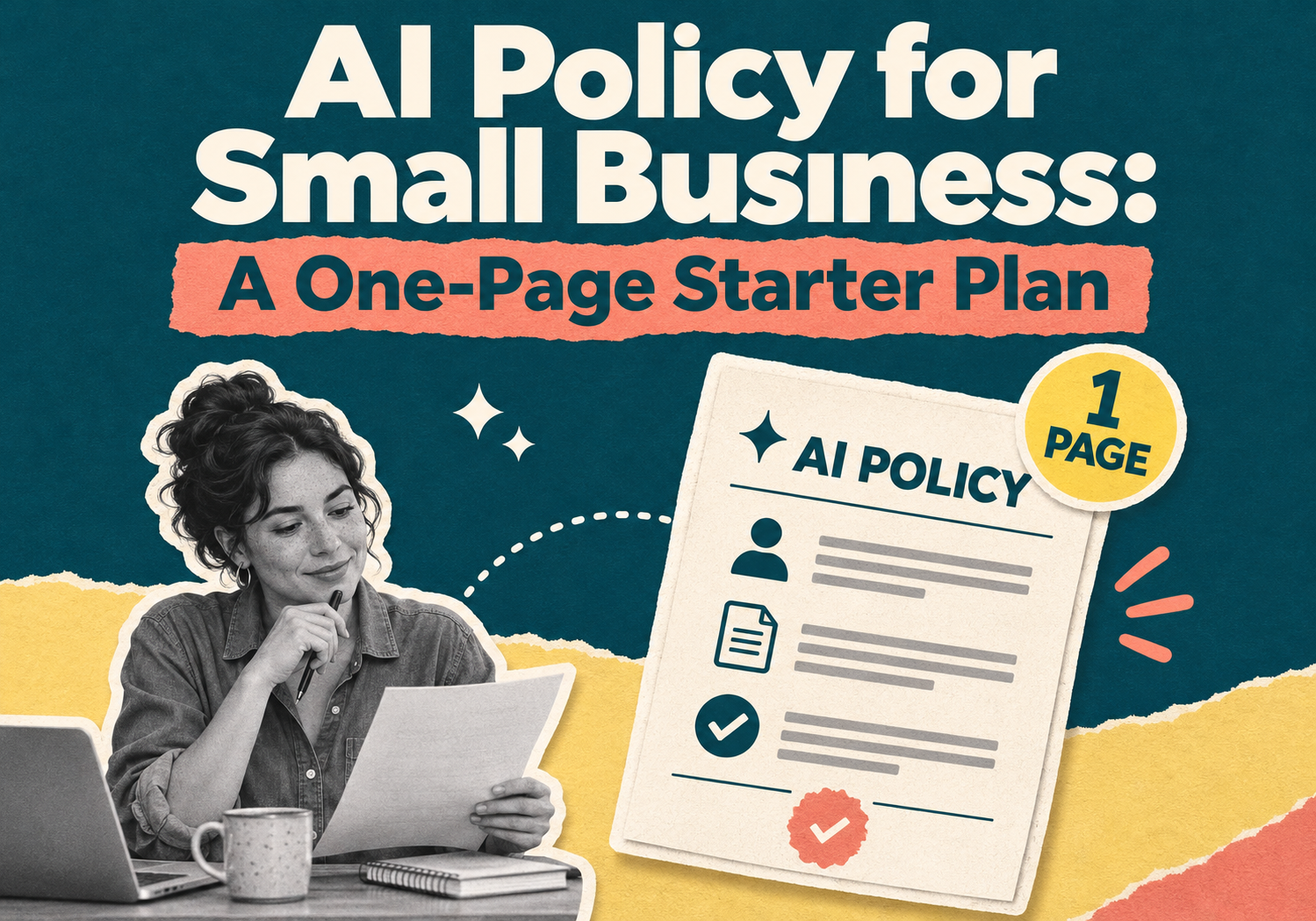
If you are searching for an AI policy for small business, this is a one-page starting point. You do not need a legal department or a 40-page binder. You need a short document your team will actually read.
Why does a small business need an AI policy now?
Because your team is almost certainly using AI tools already, and the rules around those tools are moving. Three things changed in 2026:
- AI is acting, not just answering. Entrepreneur reported on July 1, 2026 that some owners now run AI agents for client intake, email triage and customer service. The same article notes that oversight gets harder when a system makes its own plans, and that mistakes can spread fast if nobody catches them early.
- Disclosure rules started. The EU AI Act's transparency obligations began to apply on August 2, 2026. In plain terms, people should be able to tell when they are dealing with an AI system. The European Commission's guidelines, as summarized by law firm Greenberg Traurig, extend this to AI agents that contact third parties, and say a notice buried in the terms and conditions does not count. Fines can reach EUR 15 million or 3% of worldwide annual turnover, whichever is higher. Whether this reaches your business depends on whether you serve customers in the EU, so ask a lawyer if you do.
- Regulators are preparing for AI incidents. On October 12, 2026, the UK government announced measures to prepare for incidents involving AI agents, according to a November 2026 briefing from Eversheds Sutherland.
You do not have to wait for a law that names your business. A simple policy now is cheaper than cleaning up after a leak or a bad automated email.
What should a one-page AI policy include?
A useful small-business AI policy answers six questions on one page:
1. Which AI tools are approved? List them by name.
2. What data may go into them, and what may not?
3. Who checks AI output before it reaches a customer?
4. When do we tell people they are dealing with AI?
5. Who owns the policy? One named person, not a committee.
6. What do we do when something goes wrong?
The next sections take these one at a time. Write each answer in two or three plain sentences.
How do you find the AI tools your team already uses?
Start by asking, then check. Tell your team you are not trying to catch anyone, you are trying to write rules that fit how people really work. Ask what they use for writing, images, meeting notes, spreadsheets and customer replies.
Then compare their answers with your software subscriptions, browser extensions and expense reports. Eversheds Sutherland's advice to larger organizations is to keep an inventory of every AI system and use case, and to look for unapproved tools in software and network logs. For a team of 5 or 15, a shared spreadsheet with four columns is enough: tool, who uses it, what it is used for, what data goes in.
Go easy on bans. The same Eversheds briefing warns that rules that are too strict can push people toward unapproved tools, while rules that are too loose leave the business exposed.
What data should never go into an AI tool?
The safest default is: nothing you would not email to a stranger, unless the tool is on your approved list and you have checked its data settings. These are sensible lines to draw (our suggestion, not a legal standard):
- Passwords, API keys and payment card numbers: never.
- Customer personal details, health or financial records: only in approved tools with a business account.
- Contracts, pricing sheets and unreleased plans: approved tools only.
- Public marketing copy and general research: fine in most tools.
Check whether each approved tool uses your inputs to train its models and whether you can switch that off. If your customer data is scattered across spreadsheets and inboxes, that is the real problem to fix first. Our data engineering services exist for exactly that kind of cleanup.
Who should check AI output before it goes out?
A human, every time, for anything a customer, a regulator or a bank will see. Pax8's report recommends requiring a peer or manager review of AI-generated content, data analysis and scripts before anyone uses them, and that is a good rule at any size.
Make it concrete:
1. The person who used the AI reads the output line by line.
2. For anything public, financial or legal, a second person approves it.
3. Numbers, names, dates and links get checked against the original source.
AI tools can sound sure of themselves while being wrong. A two-minute check is the cheapest insurance you will buy this year.
Do you have to tell customers they are talking to AI?
In the EU, chatbot-style systems have to make it clear that the user is dealing with AI, and the Commission's guidelines recommend a clear notice at the point of interaction. In the U.S., the picture is a patchwork of state laws that keeps changing, and we did not find a single federal rule that settles it for a small business. Check with a lawyer for your state and industry.
The low-risk habit is simple: if a chatbot, voice assistant or AI agent talks to a customer, say so in the first message, and give people an easy way to reach a human.
What should you do when an AI tool gets it wrong?
Decide before it happens. Eversheds Sutherland suggests defining what counts as an AI incident, who must be told, and how lessons are recorded. A small-business version fits in five lines:
1. Stop the tool or the automation.
2. Tell the policy owner right away.
3. Work out what data or customers were affected.
4. Fix the harm: correct the message, refund the order, notify the customer.
5. Write down what changed so it does not repeat.
If the mistake involved personal data, speak to a lawyer about whether you have notification duties.
Is there a standard you can follow?
Yes. The NIST AI Risk Management Framework, released on January 26, 2023, is voluntary guidance for managing AI risk, built around four functions: Govern, Map, Measure and Manage. NIST's own page notes that version 1.0 is being revised as part of the White House AI Action Plan. You do not need to adopt all of it. Borrowing its habit of naming an owner, listing your AI uses and checking results regularly gets you most of the value for a small team.
How can 10Native help with your AI policy and AI setup?
A policy only works if the tools behind it are set up to match. 10Native is a Texas LLC headquartered in Prosper, with a sub-office in Warner Robins, Georgia and a production center in Karachi, Pakistan. Here is where we can help:
- Pick and set up approved tools that fit your workflow, through our AI and machine learning services.
- Build automations with a human step built in, so output is reviewed before it reaches a customer.
- Organize the data behind the tools with our data engineering team, so you know what an AI tool can and cannot see.
- Start small. If you are not sure where AI fits yet, our guide on where to begin with AI for small business walks through it.
We are a technology and marketing agency, not a law firm. We can help you build and run the systems, but legal questions about your obligations belong with a qualified attorney. We also cannot promise specific business results from any AI tool.
Want AI in your business without the guesswork? Tell us what you are trying to do and we will suggest a practical first step.
Talk to 10NativeTalk to 10Native
If you want help choosing, setting up or reviewing AI tools for your business, call us at 415 489 9314 or 214 758 7971, or email info@10native.com. You can also contact us here.
10Native Team
Building resilient enterprise solutions in AI/ML, Data Engineering, Fintech & Digital Marketing.