How To Structure A B2B Website For Better Buyer Engagement
A procurement manager in Chicago has forty minutes between meetings. She has three vendor websites open in three tabs, comparing a manufacturing supplier her team has used before against two companies she found this week. She is not looking for a homepage that tells her how passionate the company is about quality. She is looking for proof. She wants to see how the product performs under real conditions, who else has trusted this vendor, and what happens after she fills out a form. Two of the tabs answer that in under a minute. The third makes her hunt, scroll, and guess. She closes the third tab first.
This is happening across every industry in the United States right now, on repeat, thousands of times a day. Budgets are shrinking, buying committees are growing, and the businesses winning are not always the ones with the better product. They are the ones whose websites make the buying decision easier. That distinction is the entire reason a company works with a b2b web design and development agency instead of assembling a website from a template and hoping traffic converts on its own.
Most B2B websites were built for a different era of buying, one where a single decision-maker browsed a few pages and called a sales rep. That era is gone. Enterprise purchases today move through six to ten stakeholders, research happens across search engines and AI assistants simultaneously, and a website either supports that complexity or quietly loses the deal to a competitor who understood it earlier. A capable b2b web design and development agency builds for this reality instead of the old one, and the difference shows up directly in pipeline numbers within a quarter or two.
Stop confusing your buyers. Download our free B2B website structure blueprint and design a site that guides prospects straight to a decision.
Get the B2B Website BlueprintWhy B2B Buyers Behave Differently From B2C Shoppers
B2B buyers research in groups, compare vendors over weeks or months, and need to justify their decision to people who never visit the website themselves. A single buyer rarely acts alone, which means a site has to convince a room of people it will never meet.
Think about the difference between buying a pair of shoes and buying enterprise software. The shoe purchase is emotional, fast, and personal. The software purchase involves a finance lead worried about cost, an IT lead worried about integration, an operations lead worried about disruption, and an executive who wants to see the return on investment laid out in plain language. A B2B website has to speak to all four of those people without making any of them feel like an afterthought. That means clear pricing logic even without exact numbers, case studies that map to specific roles, and technical documentation that an IT stakeholder can actually verify. This is buyer journey optimization in its most practical form: designing pages around the questions each stakeholder is silently asking.
Why Enterprise Websites Lose Qualified Leads
Enterprise websites lose leads when the site answers questions the buyer already knows and skips the ones actually holding up the decision. Traffic looks healthy while the pipeline stays flat, because visibility was never the problem.
This shows up constantly. A company in Austin drives strong organic traffic to its homepage, yet the conversion rate sits well below industry benchmarks. The homepage talks about company values and years in business. The buyer wants implementation timelines, security certifications, and what a typical rollout actually looks like. Every page that fails to answer a real objection is a page that quietly pushes a qualified visitor back to Google to check a competitor instead. Enterprise trust signals, meaning proof points like client logos, verifiable metrics, and third-party validation, close that gap only when they sit next to the exact content a stakeholder needs at that stage, not buried three clicks deep on a separate page nobody finds.
Why Poor Information Architecture Increases Bounce Rates
Poor information architecture increases bounce rates because visitors abandon a site the moment they cannot predict where an answer lives. Confusion, not disinterest, is usually the real reason someone leaves.
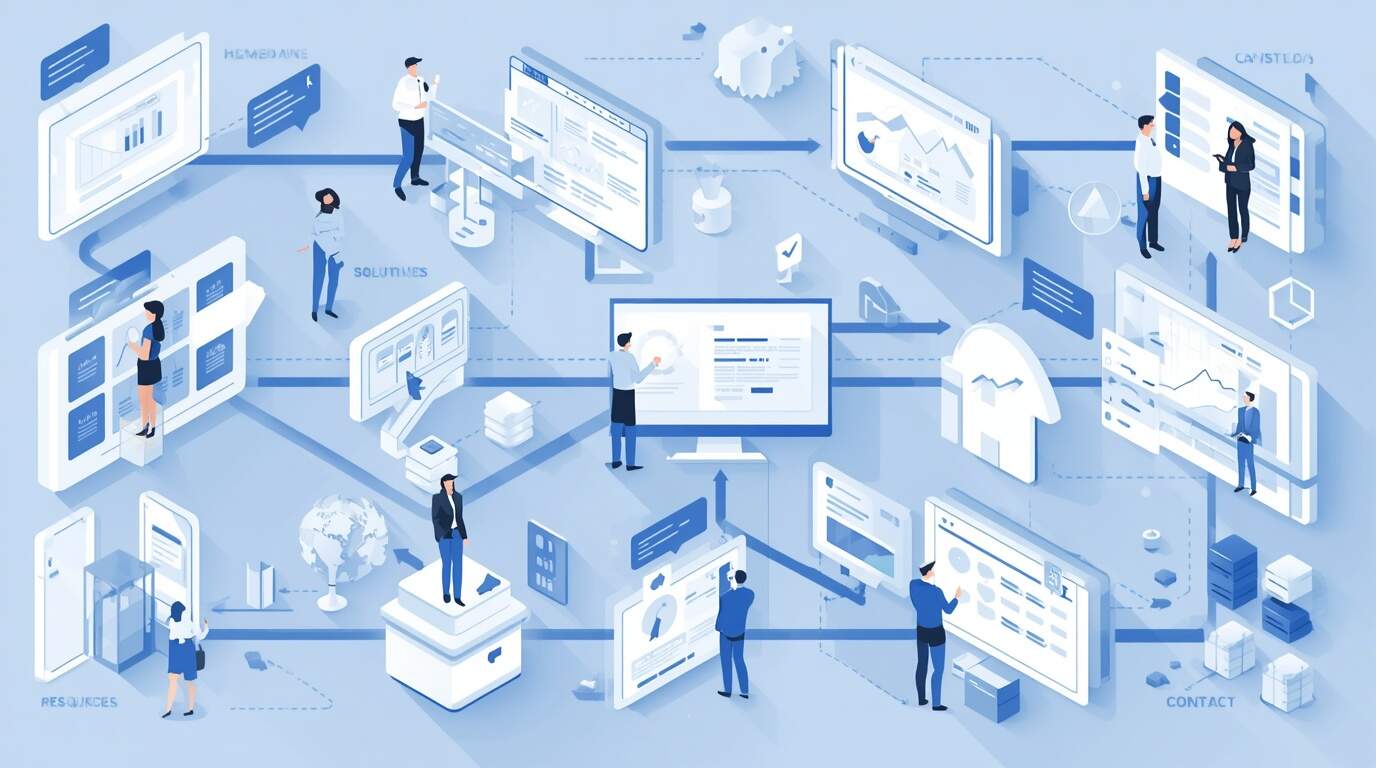
A well-structured B2B site behaves like a knowledgeable salesperson who never gets tired of answering questions in the right order. Navigation should mirror how a buyer actually thinks, not how the internal org chart is structured. A site organized around departments the company has internally, rather than the problems a visitor is trying to solve, forces the visitor to do translation work that most people simply will not do. Clean information hierarchy, logical navigation optimization, and predictable page depth reduce that friction significantly, and Nielsen Norman Group's long-running usability research consistently shows that predictable structure correlates directly with task completion, which for a B2B site means completed inquiries instead of abandoned sessions.
If your B2B site isn't engaging, you're losing deals. Enter your details and get the exact framework to structure pages that keep buyers hooked.
Send Me the Engagement KitWhy Websites Must Support Long Buying Journeys
Websites must support long buying journeys because most enterprise buyers are not ready to talk to sales the first time they visit. A site built only for immediate conversion loses every visitor who needs to come back three or four times before reaching out.
This is where content-led lead generation earns its place in the architecture. A visitor doing early-stage research needs educational content that builds category understanding without asking for anything in return. A visitor further along needs comparison content, technical depth, and specifics about implementation. A visitor near the decision needs a frictionless way to request a demo or proposal that does not feel like starting over. Lead nurturing architecture, built through resource hubs, email capture that respects timing, and retargeting that reflects where someone actually is in the journey, keeps a company visible across a sales cycle that can stretch six months or longer without feeling pushy at the wrong moment.
How Trust Influences Enterprise Purchasing Decisions
Trust influences enterprise purchasing decisions because no buyer wants to be the person who championed a bad vendor internally. Every page on a B2B site is quietly being evaluated for risk, not just relevance.
Enterprise buyers avoid information overload, but they also actively seek proof before they will commit any internal credibility to a recommendation. That proof comes from specificity. Vague claims about being industry leading convince nobody. Named client outcomes, transparent process explanations, and visible technical competence convince people who have been burned by vendors before. Buyer confidence gets built cumulatively, page by page, through consistent evidence rather than one dramatic testimonial buried on a separate page. This is buyer intent mapping in action, matching the right proof point to the right moment of hesitation.
How Ai-generated Search Results Are Changing B2B Discovery
AI-generated search results are changing B2B discovery because buyers increasingly get their first impression of a vendor from an AI summary rather than the website itself. If that summary is inaccurate, incomplete, or absent entirely, the website never gets its chance to make the case.
Google's AI Overviews, along with the broader shift toward Generative Engine Optimization, mean a website is no longer only being read by a human scrolling a page. It is being parsed, summarized, and sometimes quoted directly by an AI system answering a buyer's question before that buyer ever clicks through. This has changed how content needs to be written. Clear, direct answers near the top of a section, structured data that machines can interpret accurately, and semantic HTML that reflects true content hierarchy all increase the odds that an AI system represents a company correctly, or represents it at all, when a prospective buyer asks a conversational question about who solves their problem best.
Why Semantic Content Architecture Matters
Semantic content architecture matters because search engines and AI systems no longer rank pages, they rank entities and the relationships between them. A site that clearly defines what it is, what problems it solves, and how those topics connect earns more visibility than one relying on keyword density alone.
Semantic SEO works by building topic clusters around core themes, connected through deliberate internal linking rather than scattered pages competing against each other. A company offering ecommerce web development services, for example, benefits from linking that page naturally to related resources, including deeper guides such as 15 Shopify Design Mistakes That Kill Ecommerce Sales and Why Most Shopify Stores Struggle To Rank on Google, so that search engines and AI systems understand the full scope of expertise rather than treating each page as an isolated fragment. This is semantic entity optimization at work, and it is one of the clearest signals separating an outdated site from an AI-ready one.
Not sure if your structure works? Request a complimentary B2B engagement review and we'll show you what's turning buyers away.
Claim Your Free Site ReviewWhy Modern B2B UX Is Built Around Buyer Confidence
Modern B2B UX is built around buyer confidence because hesitant buyers do not convert, they stall. Every design decision, from page speed to form length, either reduces that hesitation or adds to it.
Executive user experience deserves specific attention here, because decision-makers rarely have patience for slow load times or confusing forms. Core Web Vitals, image optimization, lazy loading, script deferral, and CDN delivery are not just technical checkboxes. They are trust signals. A site that loads instantly and feels effortless communicates competence before a single word is read. A site that stutters, or asks for fifteen form fields before offering any value in return, communicates the opposite, and enterprise buyers notice immediately.
How Conversational Search Impacts Enterprise Websites
Conversational search impacts enterprise websites because buyers now phrase questions the way they would ask a colleague, not the way they used to type into a search bar. A website has to answer those natural-language questions directly to show up in voice search and AI-generated summaries.
This means headings and content need to reflect real questions rather than generic labels. A page titled simply "Services" tells search engines and AI systems very little. A page structured around a question like how does a wordpress web development company support enterprise growth gives both a direct answer and the surrounding context an AI system needs to summarize accurately. Conversational search optimization, sometimes called AEO or Answer Engine Optimization, rewards this structure consistently across Google AI Mode, voice assistants, and traditional search.
Why Website Structure Directly Affects Pipeline Growth
Website structure directly affects pipeline growth because every point of friction removed from a buyer journey translates into a measurable increase in qualified inquiries. This is not a soft metric. It shows up in GA4, in heatmap analysis through tools like Hotjar or Microsoft Clarity, and in the actual revenue numbers a sales team reports each quarter.
Behavioral analytics reveal exactly where buyers hesitate, scroll past, or abandon a page. A heatmap showing that visitors never scroll past the second section of a services page is not a minor detail, it is a direct signal that the value proposition is buried too deep. Companies that treat their website as a living system, continuously measured and refined through conversion funnel analysis, consistently outperform companies that build a site once and leave it untouched for three years.
Stop building for search engines—build for buyers. Grab our buyer-focused site structure template and start engaging decision-makers from the first click.
Get the Buyer-First TemplateHow 10 Native Structures B2B Websites Differently
10 Native structures B2B websites around the buyer, not around the org chart or internal preferences of the company footing the bill. Every architectural decision starts with the same question: what does this specific visitor need to feel confident moving forward.
That approach shows up across the type of work 10 Native does for clients, whether the engagement involves Shopify website development services for a growing ecommerce operation, a custom web design and development agency rebuild for a company outgrowing its current site, or ongoing support as a Digital Marketing Agency in USA helping a business turn traffic into pipeline instead of just impressions. The technical execution matters, but it is always in service of buyer psychology first. Semantic SEO integration, AI readable structures, and performance-first development are treated as one connected system rather than separate line items, because a fast site with weak content converts poorly, and rich content on a slow site never gets read.
Where many agencies still default to brochure-style websites, generic layouts, and template-driven design that looks acceptable but converts poorly, 10 Native builds buyer-first architecture from the first strategy session. This includes structured data and schema markup for AI crawlability, accessibility optimization that widens the audience a site can actually serve, and conversion-focused UX grounded in real behavioral analytics rather than assumptions. It is a meaningfully different starting point, and it produces a meaningfully different result.
What a Strong B2B Homepage Should Actually Contain
A strong B2B homepage should immediately answer three questions: what this company does, who it serves best, and what a visitor should do next. Everything beyond that is supporting evidence.
A homepage trying to say everything to everyone usually ends up saying nothing clearly to anyone. The strongest B2B homepages resist the urge to list every service and instead guide different visitor types toward the specific page that speaks to their situation, whether that is a case study relevant to their industry, a service page matching their exact need, or a direct path to a conversation. Clear CTA hierarchy matters here too. A homepage with six competing calls to action confuses visitors into taking none of them.
Comparison Table: Outdated B2B Website vs AI-Ready B2B Website
| Website Element | Outdated Approach | AI-Ready Approach |
|---|---|---|
| Homepage | Generic mission statement with no clear next step | Clear value proposition featuring role-based navigation |
| Content | Keyword-stuffed, thin, and overtly promotional | Semantic, structured, and designed to answer real buyer questions |
| Navigation | Organized around internal company departments | Organized around buyer problems and journey stages |
| Technical Foundation | Slow load times with missing structured data | Fast, schema-rich, and built specifically for AI crawlability |
| Trust Building | Vague claims isolated on a single testimonials page | Specific proof points woven throughout every relevant page |
| Search Visibility | Ranks for a handful of exact-match terms | Cited in AI Overviews and conversational search results |
| Measurement | Website traffic reported without business context | Behavioral analytics tied directly to pipeline outcomes |
A Quick Buyer-Ready Website Checklist
- Homepage answers what, who, and what next within seconds- Item two
- Every service page maps to a real buyer question or objection
- Case studies are specific, named, and role relevant where possible
- Site speed and Core Web Vitals are consistently in healthy ranges
- Structured data and schema markup are implemented correctly
- Internal linking connects related content into clear topic clusters
- Forms are short, and value is offered before a large ask
- Content is monitored through GA4, Search Console, and heatmaps
- Headings reflect natural buyer questions, not internal jargon
B2B buyers don't browse—they evaluate. Fill out the form and get the proven architecture that keeps them engaged until they're ready to buy.
Unlock Smarter Engagement NowWhy Most Shopify Stores Struggle With B2B-Style Buying Journeys
Interestingly, many of the same structural problems that hurt enterprise buyers also hurt Shopify sellers trying to convert higher-consideration purchases. The reasons echo two patterns 10 Native sees constantly in ecommerce audits, covered in depth in Why Most Shopify Stores Struggle to Rank on Google and [Why Most Shopify Stores Fail at Converting Visitors Into Buyers](https://10native.com/blog/why-shopify-stores-fail-to-convert-visitors-into-buyers. In both worlds, a beautiful storefront or website is not enough on its own. Structure, semantic clarity, and buyer confidence are what actually move a visitor toward a decision, whether that decision is a single checkout or a six-figure enterprise contract.
Where Geography Still Shapes B2B Web Strategy
Buyer expectations shift subtly by region, and a national B2B strategy benefits from acknowledging that rather than ignoring it. A manufacturing buyer in Houston researching industrial suppliers looks for different proof points than a fintech buyer in New York evaluating a software partner. A logistics company in Atlanta cares about operational reliability messaging in a way a creative agency in Los Angeles rarely does. Companies serving clients across Chicago, Dallas, Austin, Seattle, Boston, Denver, San Francisco, and Miami often benefit from location-aware content and case studies that reflect the specific industries clustered in each market, without ever sacrificing the core structural principles that apply everywhere.
Frequently Asked Questions
How should a B2B website be structured for the best buyer engagement?
A B2B website should be structured around buyer questions and journey stages rather than internal company departments, with clear navigation, fast performance, and proof-driven content at every stage of the funnel.
What makes enterprise websites actually convert?
Enterprise websites convert when they reduce hesitation through specific proof, clear next steps, and content that matches exactly where a buyer sits in their research process.
Why do most B2B websites fail to generate qualified leads?
Most B2B websites fail because they focus on company messaging instead of buyer questions, leaving real objections unanswered and pushing visitors back to search for a competitor.
How should I structure my B2B website for better conversions?
Structure it around your buyer's questions at each stage of their journey, keep navigation simple, and back every claim with specific proof rather than general statements.
What does a b2b web design and development agency actually do?
A b2b web design and development agency builds websites around buyer psychology, technical performance, and semantic SEO, turning a company's site into a system that generates and nurtures qualified leads instead of just displaying information.
Why are enterprise buyers leaving my website without contacting us?
Enterprise buyers usually leave because the site fails to answer a specific objection they have, the navigation feels confusing, or the trust signals needed to justify a purchase internally simply are not visible.
How does SEO influence buyer engagement on a B2B website?
SEO influences engagement by determining whether the right buyers find the site at all, and semantic, well-structured SEO ensures those buyers land on pages that actually answer their questions.
Why should a company invest in ecommerce web development services if they primarily sell to businesses?
Many B2B companies now sell through ecommerce-style self-service portals for repeat orders, and strong ecommerce web development services ensure that experience is as trustworthy and frictionless as the core website.
Conclusion
A website is no longer a digital brochure sitting quietly in the background of a company's growth strategy. It has become the first stakeholder in almost every enterprise buying decision, doing the work of a knowledgeable salesperson before a human ever picks up the phone. The businesses winning larger deals in 2026 are not necessarily the ones with the biggest budgets. They are the ones whose websites respect how modern buyers actually research, compare, and build internal consensus, and whose structure holds up whether it is being read by a procurement manager at midnight or summarized by an AI system answering a question that same buyer typed into Google that morning.
That is the standard a genuine b2b web design and development agency should be building toward, and it is the standard 10 Native holds every engagement to, whether the work involves a full custom web design and development agency rebuild, focused Shopify website development services, or an evolving partnership as a Digital Marketing Agency in USA guiding a company's growth over years rather than a single project. As AI systems take on a larger role in how buyers discover and evaluate vendors, the companies that treat their website as a living, buyer-first system today will be the ones still winning the room full of stakeholders tomorrow.
One well-structured page can be the difference between a bounce and a deal. Share your details and we'll send the system to structure your site for real buyer engagement.
Start Engaging Today10Native Team
Building resilient enterprise solutions in AI/ML, Data Engineering, Fintech & Digital Marketing.